Rainy days are perfect days to make something fun!

Judah and drill bitWith the drought going strong, this rainy weekend has been a blast and a blessing. But what to do with 4 kids who are so used to playing outside every single day? Make something everyone can help with!

I’ve been wanting to make something for Atticus for a while, now. When you are 5th in line of 4 living kids, you get a LOT of used stuff, and few things you can call your own. Not that this is a terrible thing. It’s more that I have made so many fun toys for my other kids, and Atticus has yet to receive a single one! I have several wine crates I picked up at Costco one year and have used them for garage storage for several years, and one day I took one down for Judah’s American Boy dolls to sleep in while he earned his Ikea doll bed. With the doll bed earned, the wine crate hung around, used as a a place for sitting and reading, a crate for hauling junk around the house, and a stepping stool. And then it hit me: A WAGON FOR ATTICUS!!! Becuase we really need another wagon in this house.

So I stopped at Home Depot on my way home from teaching one day and bought some wheels, nuts, washers, and bolts. The project has been sitting around since then just waiting for the proper moment for assembly. Today that moment arrived.

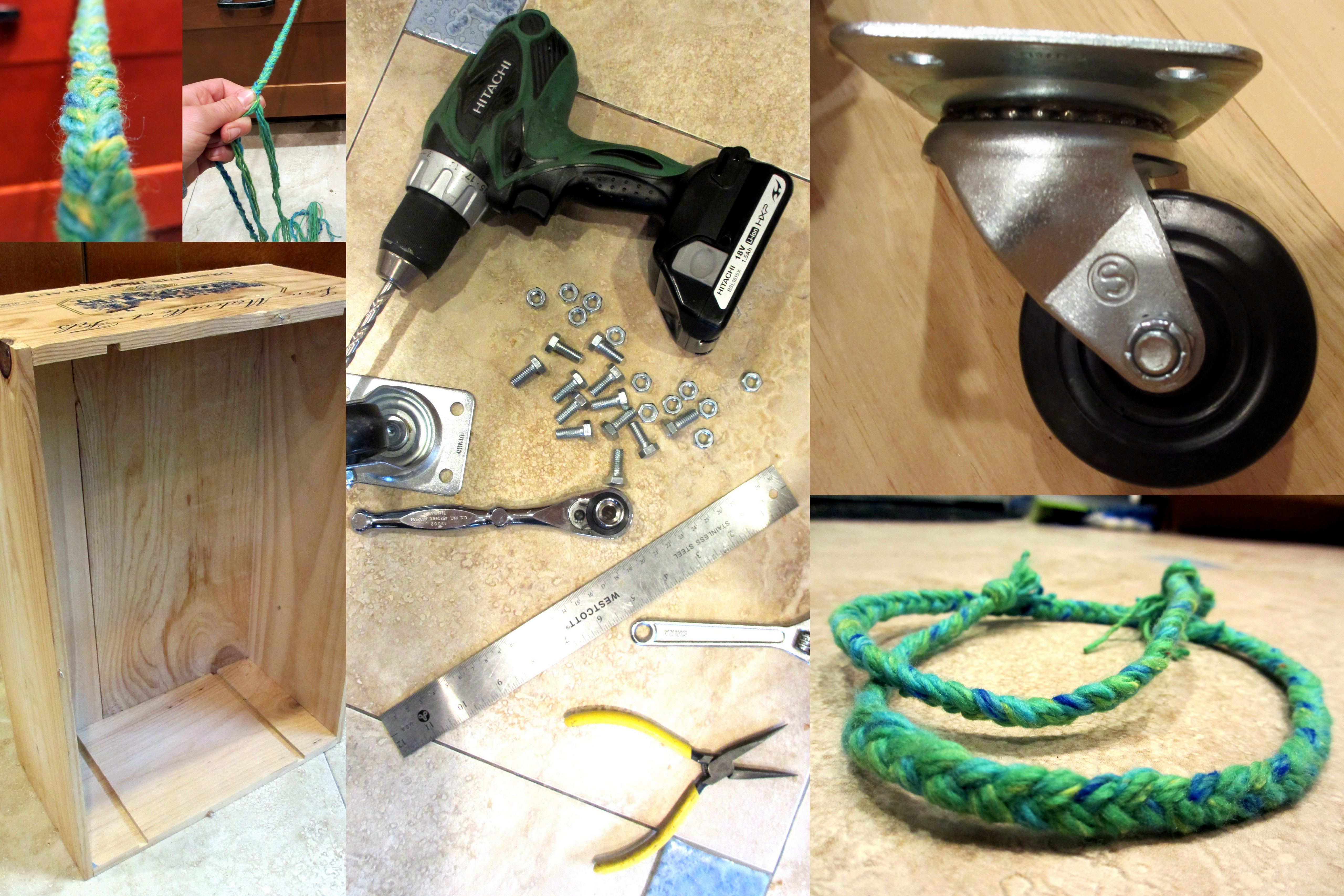
We gathered our supplies:

1. 1 wine crate (an unfinished wooden crate from Michael’s would do, as well, but you’ll want Home Depot to cut you a piece of 1/4-1/2″ wood to nail to the bottom for re-inforcement.

2. 4 wheels: I purchased the 2″, non-locking, 100lb, 360 degree rotating wheels, but there are many kinds to choose from. Just make sure it has a flat plate with 4 screw holes for assembly rather than a post. I purchased the larger wheels because we have carpet in the house and I wanted something that could handle it. I also have a big 7-year-old who I knew would want to play in the wagon, so I needed something that could handle her weight-wise! Each wheel cost about $5.

3. 16 bolts slightly smaller than the screw holes on the wheel plates. Buy the length that is short enough so that they will not get in the way of the rotation of the wheels, but long enough to leave a little extra after the bolt is on. My wheels and crate floor required 3/4″ 5/16 bolts. You don’t need the fancy ones for outdoors, get the cheapest ones! Mine cost $.24 nut and bolt.

4. 17 washers for the bolts and for the rope hole.

5. 16 nuts for the bolts.

6. 1 power drill

7. 1 power drill bit the same size as the bolts

8. 1 ratchet wrench and bit the same size as the nuts and bolts

9. 1 crescent wrench.

10. 1 ruler

11. 1 pencil

12. About a yard of soft, medium-gauge rope that will string through one of the washers. If you want something more exciting, you can braid about 15 strands of multi-colored yarn to length. You can skip the rope if you are concerned about strangulation. You will have a REALLY fun crate on wheels rather than a wagon. 🙂

Wine crate wagon1


This is how we put it together:

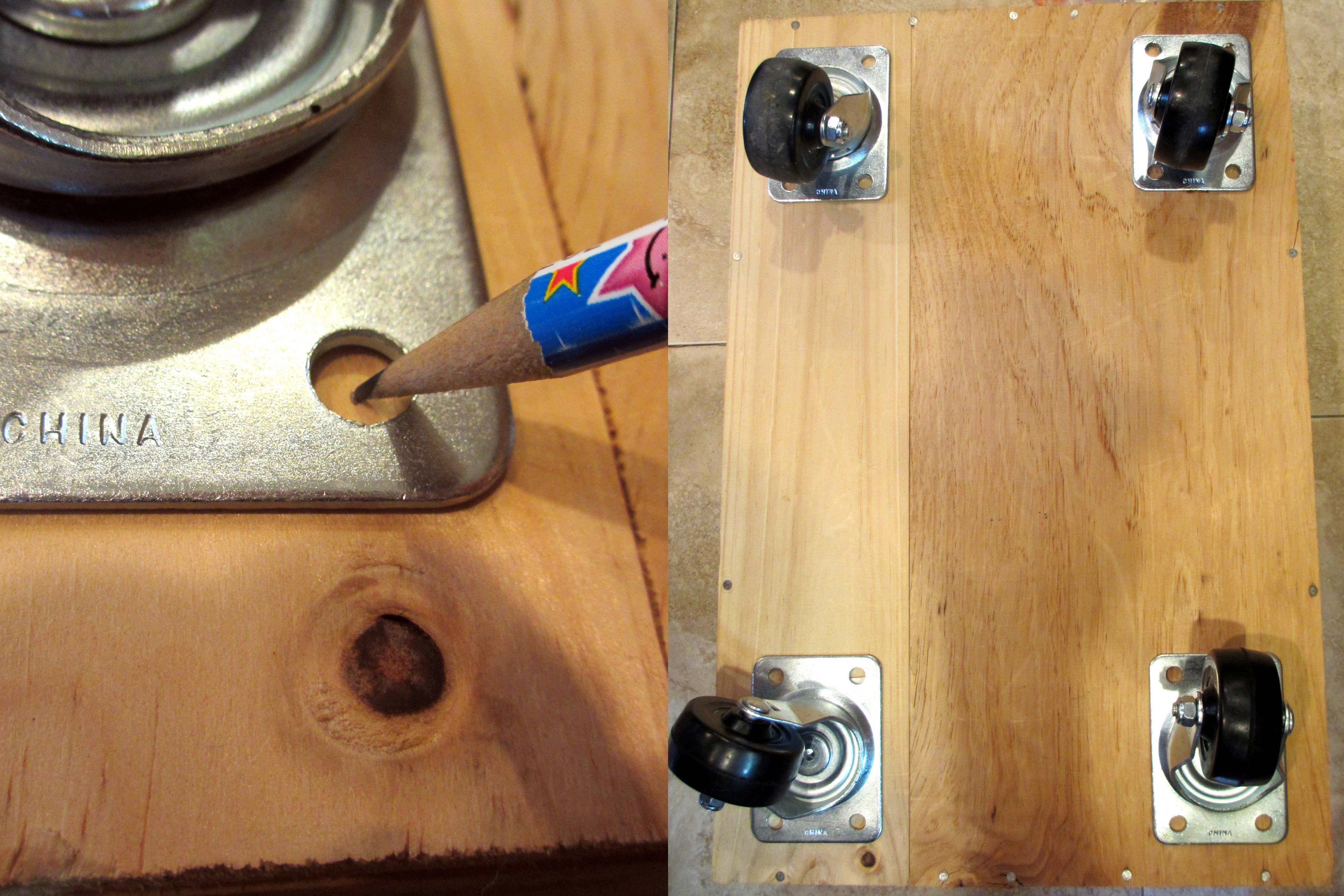
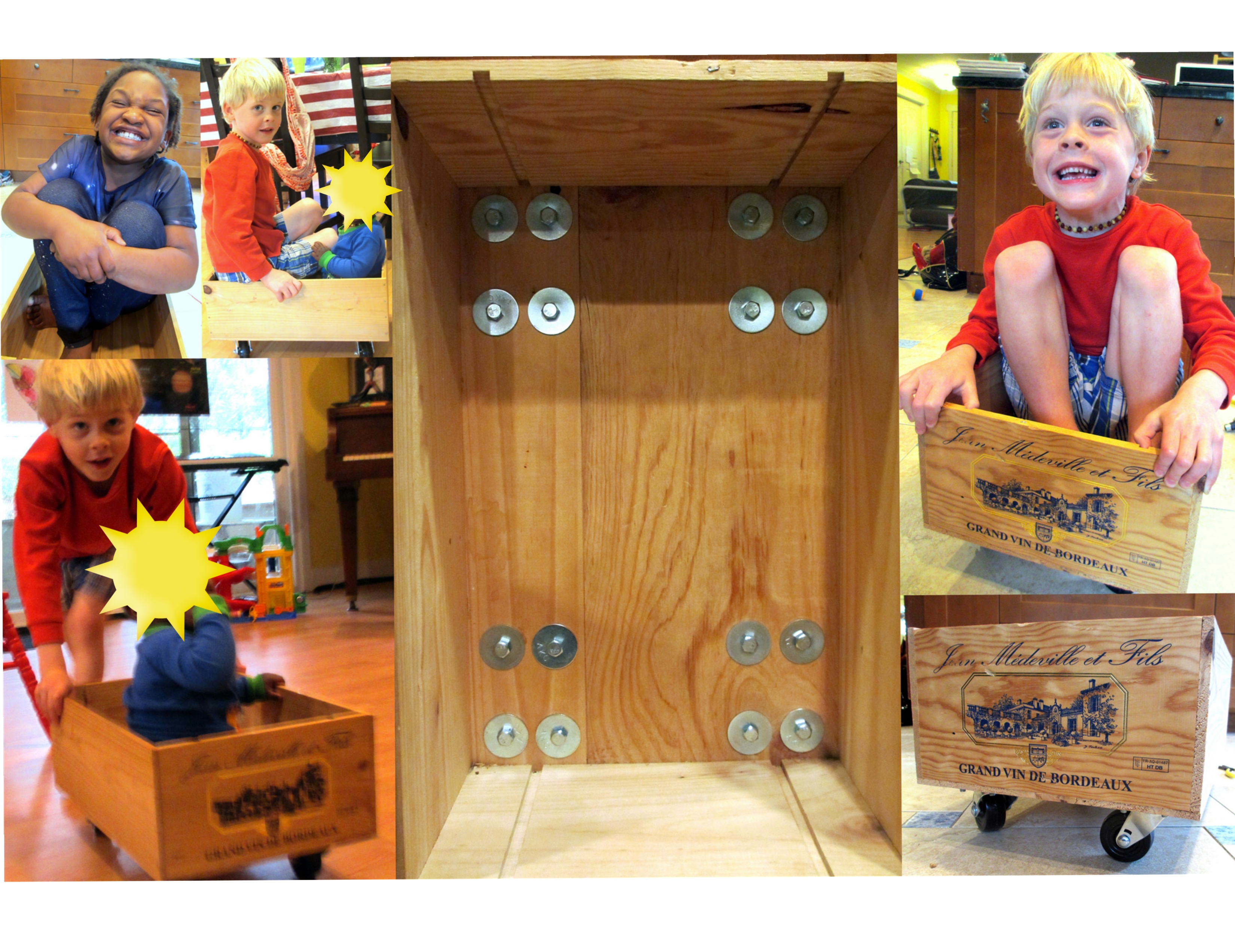
I wanted the kids to help as much as possible, so we first turned the crate over and marked the dots for our drill holes. I wanted to make sure we put the bolts far in enough it from the walls of the crate so we didn’t accidentally drill into the crate wall. We therefore measured each hole 1″ from the edge on each parallel side:

Then we marked the holes with a dot and pushed the pencil into the wood to create an indent. This will give the tip of the drill something to rest in so you’ll drill exactly in the right spot.

Wine crate wagon2

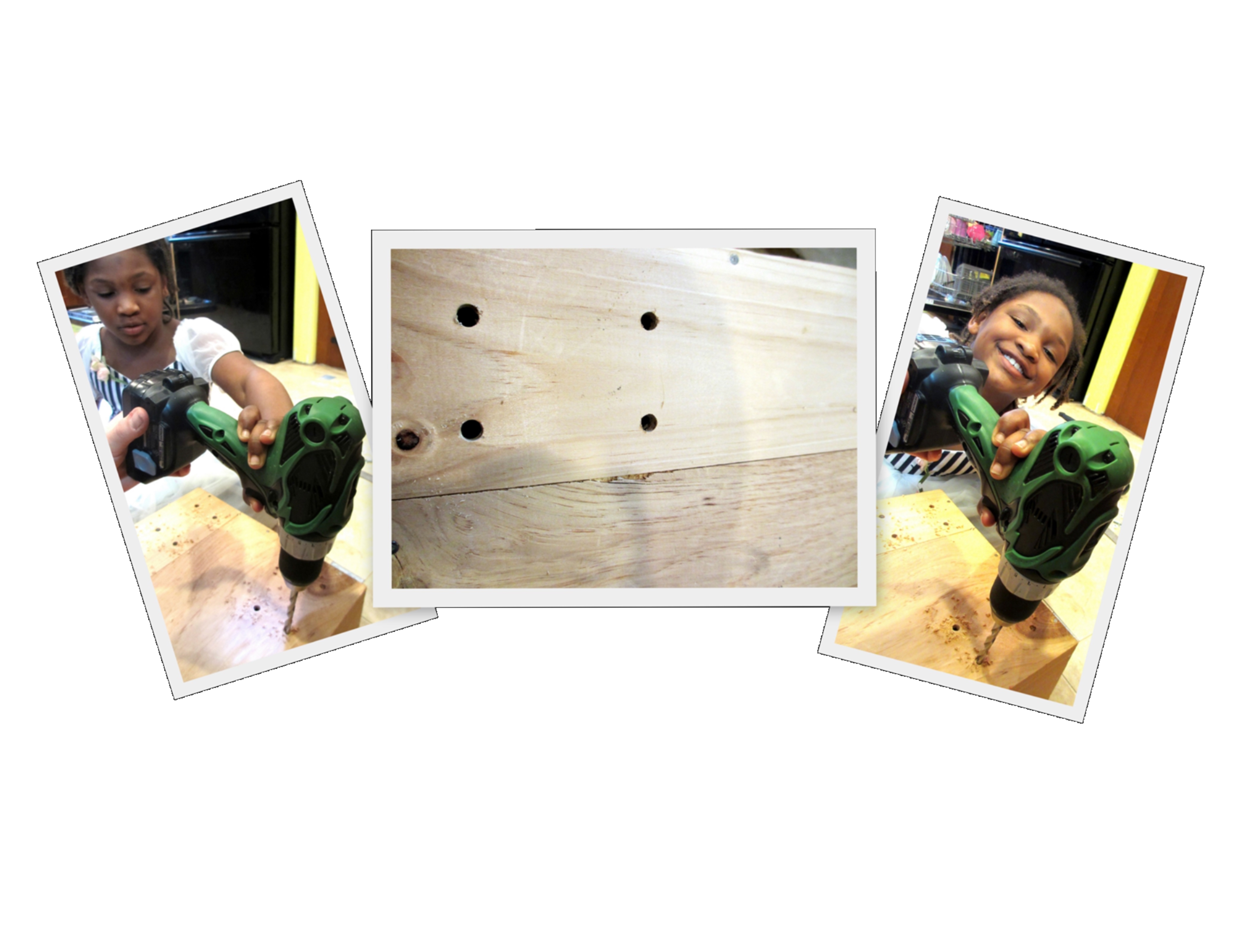
Next, we drilled. Begin at a slow speed so that you dig a divot with the drill before you increase your drill speed, or your drill may drift, resulting in an off-center bolt hole. The kids each pulled the drill trigger for a few holes and were able to figure out the drill speed, mastering the slow-to-fast method. I held the drill straight and stable for them. 🙂

Kiki Drilling 3 - Page 090

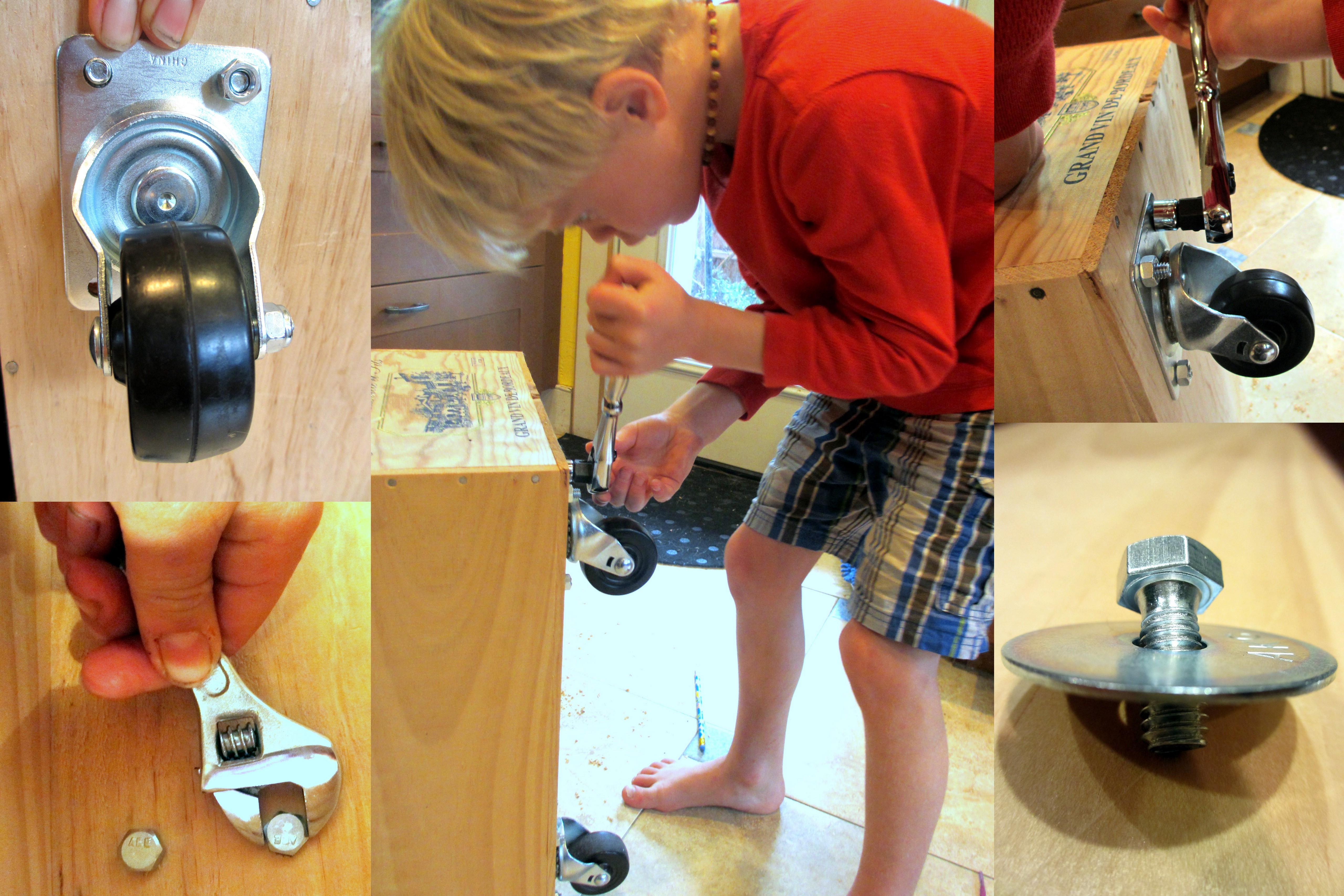
After your bolt holes have been drilled, turn your crate on it’s side and hold one wheel in place, bolt holes lined up with the ones you drilled into the bottom of the crate. Put a washer on each bolt and slide them, from the inside of the crate, into the bolt holes for one wheel. Place a washer on each bolt and finger tighten. The kids were able to do this step by themselves.

Using your ratchet wrench on one side and your crescent wrench on the other, tighten down the bolts. The bolts should be nice and snug, but not so tight that the washer warps or you hear wood crackle. One of my kids worked the ratchet on the nut while another held the bolt head with the crescent wrench on the other side. Repeat with each of the other 3 wheels.

Wine crate wagon6

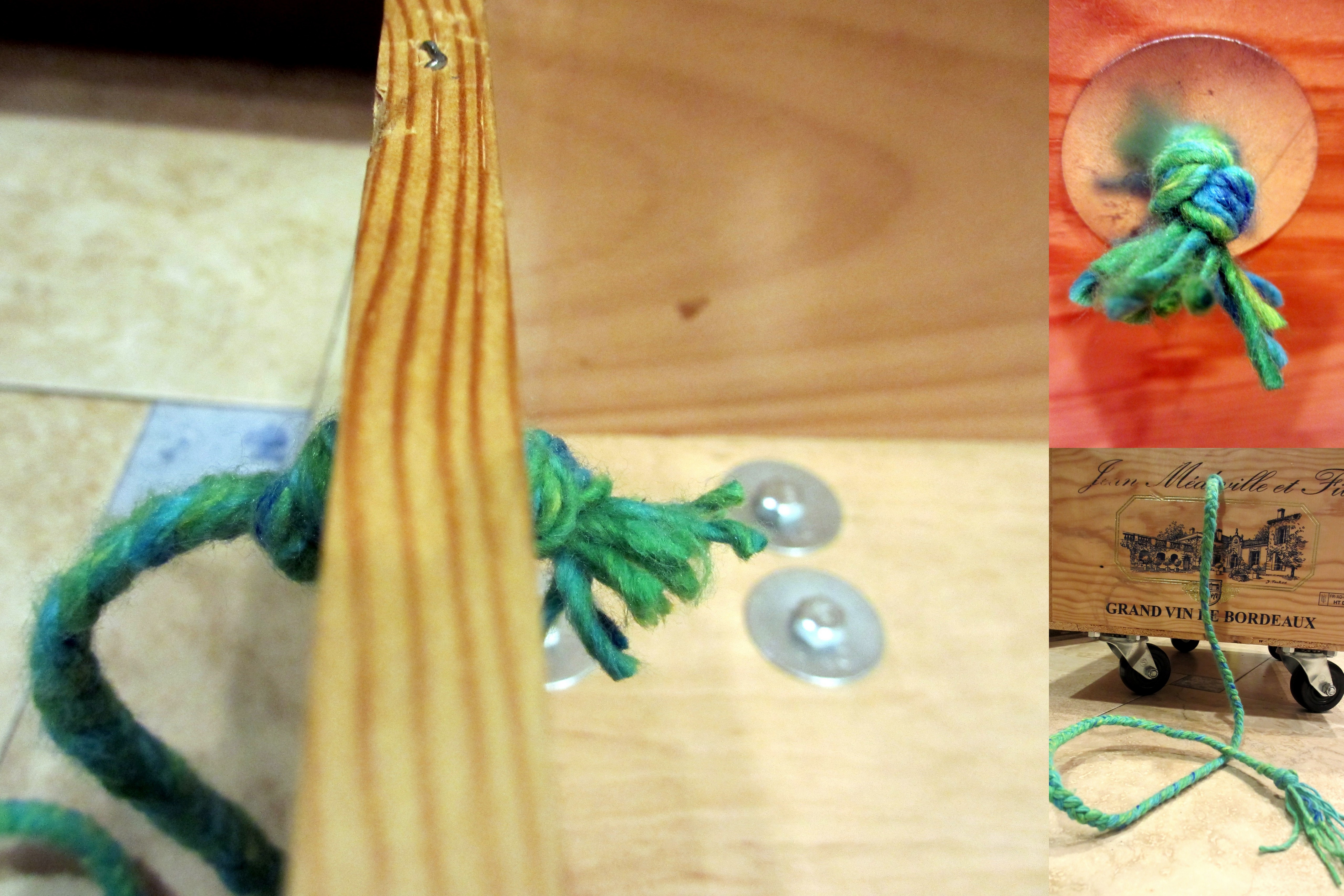
Drill a hole through the center of one of the narrow ends of the crate about 1″ down. String the last washer onto the the rope and tie a knot. Thread the rope through the hole you have just drilled such that the washer is on the inside of the crate. The washer is just a little extra insurance that as the wooden hole wears and becomes larger over time, the knot in the rope does not slip back through the hole. Tie another knot just on the outside of the crate so that the rope does not pull back into the crate. This will avoid friction that may weaken and break the rope. Tie a knot at the end of the rope farthest from the crate.

Wine crate wagon5

Last, put the baby into the wagon and watch him giggle and squeal as the other kids pull him around the house!

finished 1 - Page 090(Sorry about the sunshine face rather than an actual baby face. I can’t show him until his adoption papers are signed! 🙂 )


Categories: Homeschooling, Kid-o things, Uncategorized

On how a bouncie ball saved my life, and why I sympathize with Monty Burns

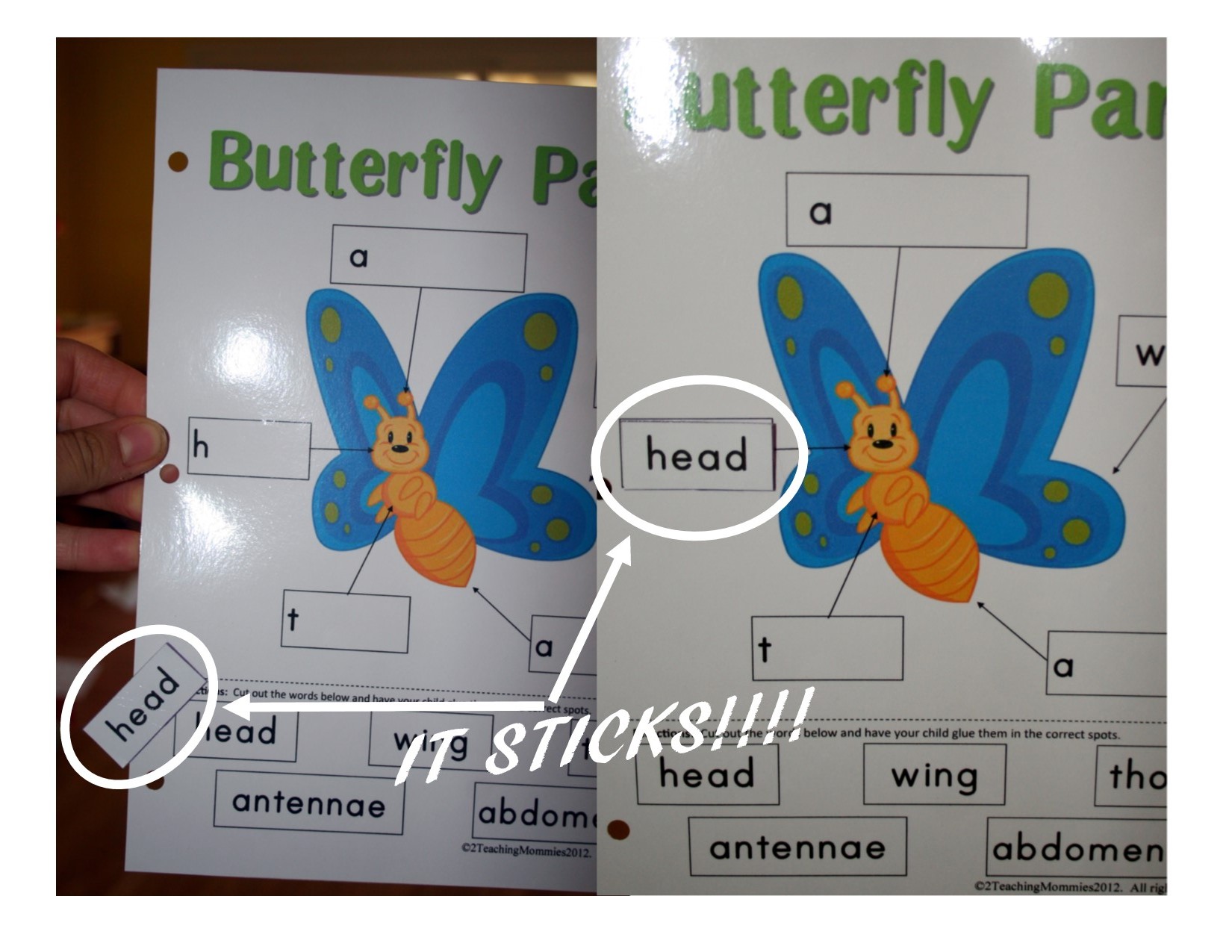
I am a committed miser. Well, not in every way, but I am committed to exploring as many ways to become a miser as I possibly can, no matter how much it costs me to get there! So my latest engineering project asks this question: what is the cheapest, most efficient way to temporarily attach game pieces and paper doll pieces to a play board? This is so important because modern mothers don’t want pieces sliding around, but gluing game pieces to our file folder games, etc., is just silly. We need something in between. My quest is finally at an end, for now. Because this fix is not perfect, it’s just amazingly close to perfect.

1. Magnates: These seem like an obvious choice. After all, you magnetically attach paper to refrigerators, so why not use 2 magnates to stick laminated papers together in this case? It’s not a bad choice, but it’s not a perfect choice. If the game base is black, or has minimal pictures, this might work. One solution, when there are many pictures, is magnetic tape sandwiched between the picture and the file folder or between two pieces of paper to hide it. The main issue with this method is that unless you are using a very strong, expensive magnetic tape, it is just not strong enough to do the job unless the game is played quietly at a table, every time it is played. Long ago I learned that a life at a table is dull and lame, and so I need something stronger that can be used in the car, at the park, in a doctor’s office, jostled by several kids, and the game pieces won’t move. I needed something else.

* Of course, if your game is to be played on a cookie sheet or other magnetic surface, then magnetic tape is the cheapest way to go. Laminate your printed objects, use double-sided tape to stick to the magnetic tape (the adhesive on the magnate is generally weak and lame, so you need extra support), and stick the magnate to the back!)

2. “Restickable dots: These babies are awesome. They are about as amazing as they come. They are just SO STICKY! Furthermore, adhering them to the back of your game objects is a challenging. I used double-sided tape and cut a tiny bit of the dot for each game piece. This works, but it’s tiresome to assemble, and it doesn’t look very neat and clean. And it’s SO sticky. The sticky is tolerable because it’s not adhesive, it’s just, well, a sticky dot. The dot eventually gets a little dirty, and then it’s not as sticky, but when it loses it’s sticky, you are supposed to rinse it in water. This becomes a problem quickly when you are talking about washing a laminated piece of paper just to rinse the sticky dot on the back. More mess and trouble than its worth. There must be a better way.

3. Velcro: Velcro is very much like magnates in it’s usability. It works well when you don’t have a picture on your game board, but when you do, you suddenly end up with Velcro ruining the aesthetics of the picture, or covering the picture completely. It also makes the game pieces very bulky. Boooooo! Velcro is pretty awesome, though, because it is CHEAP when you buy it on a roll, and it sticks nicely to laminated sheets, and really to anything you want it stuck to. It is perfect for classroom calendars with the date pieces you re-arrange each month, but only adequate for file folders/paper dolls/etc.

4. Felt and flannel: These media are nice for paper dolls, certainly. So easy to use, as well. You just buy some ink jet printable fabric transfers, print your pictures, iron them onto your felt sheet, and cut them out. Nice and neat. I have made flannel file folders, but they just get bulky. Felt is much better for use with felt boards and “paper dolls,” but it will work with a file folder game.

I REALLY wanted something more streamlined. I wanted something I could stick to the backs of the game pieces. What I really wanted was something like static cling, but finding affordable static cling is like finding the lost city of Atlantis. It just doesn’t exist at under $1 per sheet. No miser will pay that! I started looking around the house for something that might act as static cling. The kid’s broken swim cap? Nope, not sticky enough. Plastic table cloth sheeting? Nope, not sticky enough. No-skid throw rug backing? Nope, too bulky, and not sticky enough. Rubber washers? Oh, now I was just getting desperate and silly. No, none of these worked. And then I got distracted by my Little Magpie, so sad because her huge, cheap Walmart bouncie ball had popped. Yes, the ones you find in those huge cages and wish you’d had as a kid, but hope nobody every buys for your kids. Yup, the ones that cost a whopping $2.50 and deflate after a few weeks. Absolutely, the ones you can’t WAIT to find outside so you can sneak them into the trash before your kids notice. That bouncie ball. But this was different. This one had popped, exposing the inside of the ball. The sticky, shiny, STATIC CLING INSIDE OF THE FREAKING BOUNCIE BALL!!! I would have shouted a naughty word in glee, had my mother not been standing right there, and one never shouts such words in front of mothers or nice church ladies. 🙂

5. The inside of a huge, cheap, stupid, caged bouncie ball from Walmart. Her’s what you do. Print your work on regular paper, not card stock, and laminate it. You can use card stock, but it works far nicer with the the flexibility of paper. Cut out your paper shapes. Cover entirely the back of your paper shape with double-backed tape. Stick the piece to the outer side of a popped bouncie ball. Cut around the shape. Stick your shape to stuff.

HADES YEAH!!!!!! My soul is over joyed.

This is what descendants of engineers stress about in the wee hours of the morning. Now I can sleep well…until the next engineering problem arises!

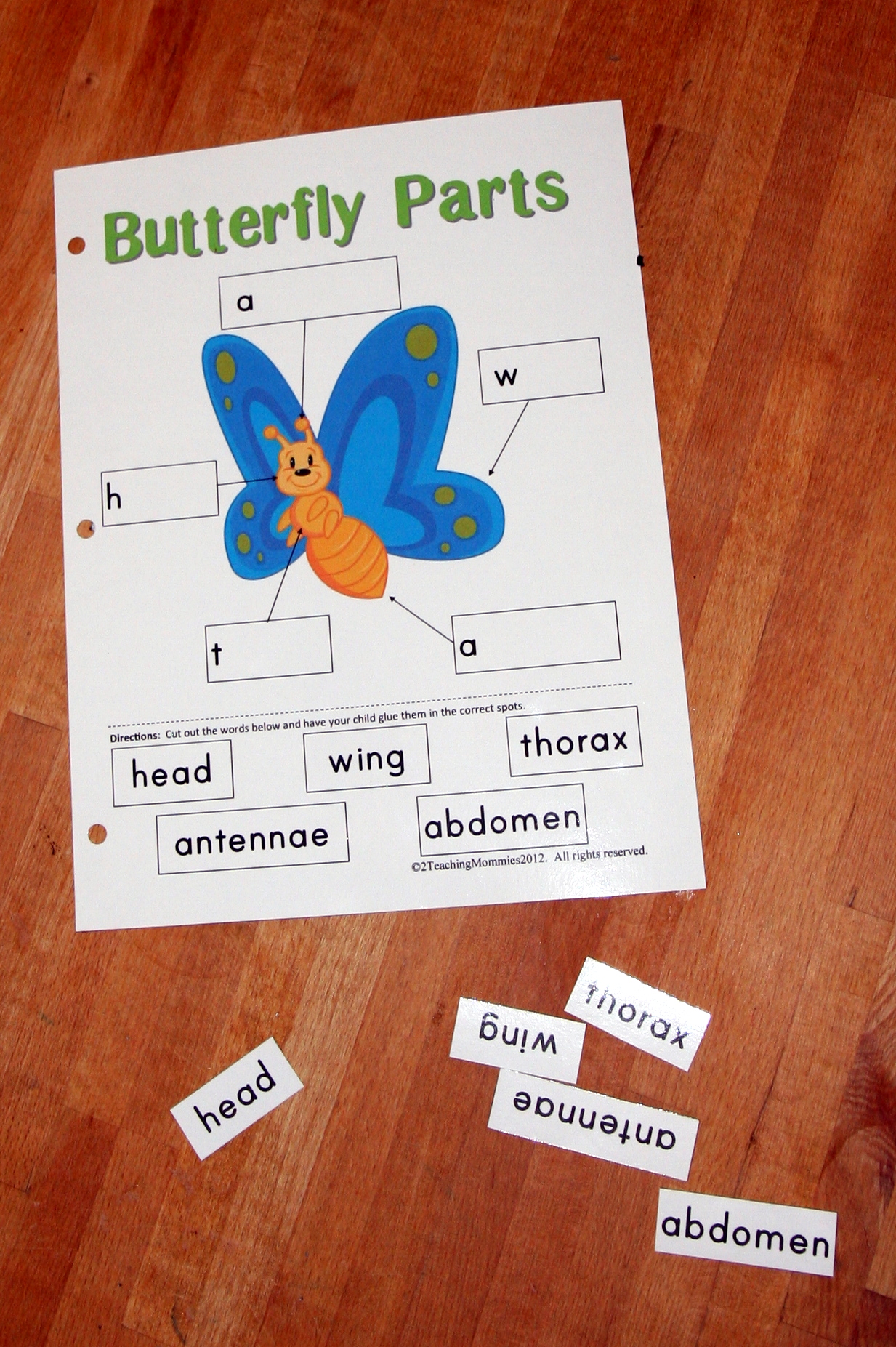
All parts, cut out, unassembled

All parts, cut out, unassembled

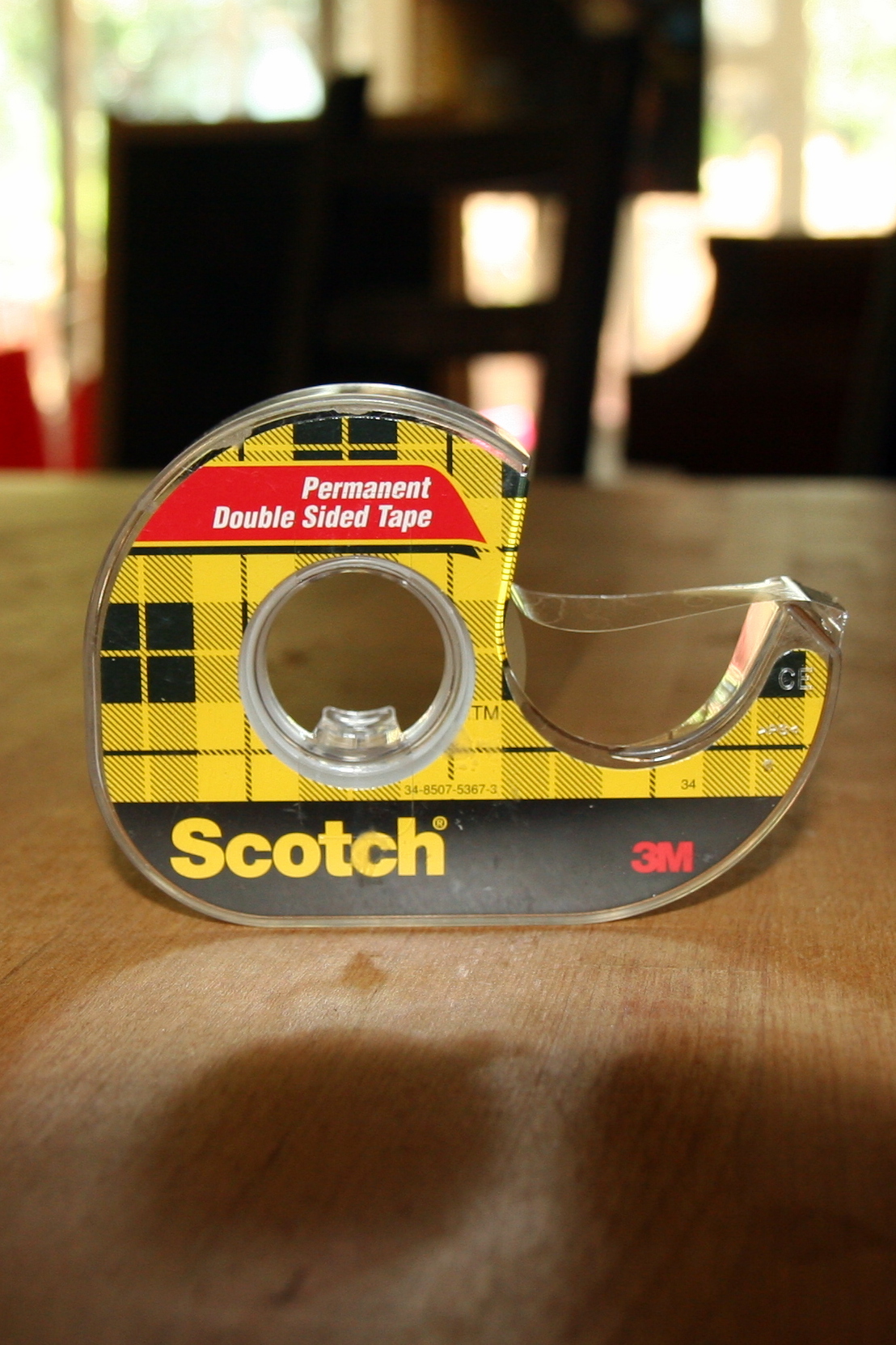
Double sided tape. I have a major crush on double-sided tape. MWWAAAAAA!

Double sided tape. I have a major crush on double-sided tape. MWWAAAAAA!

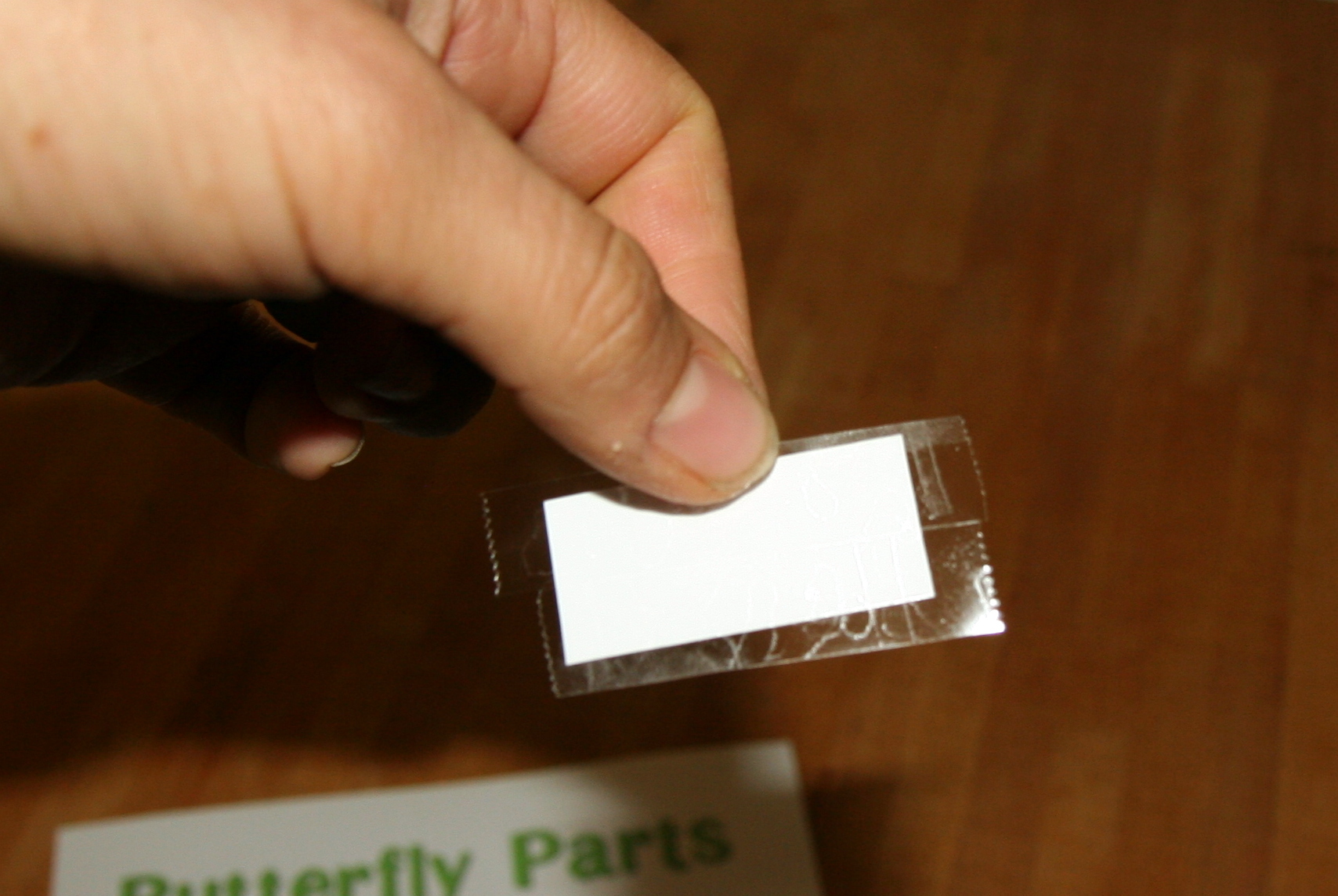
That's double-sided tape on the back of one of my game pieces.
That’s double-sided tape on the back of one of my game pieces.

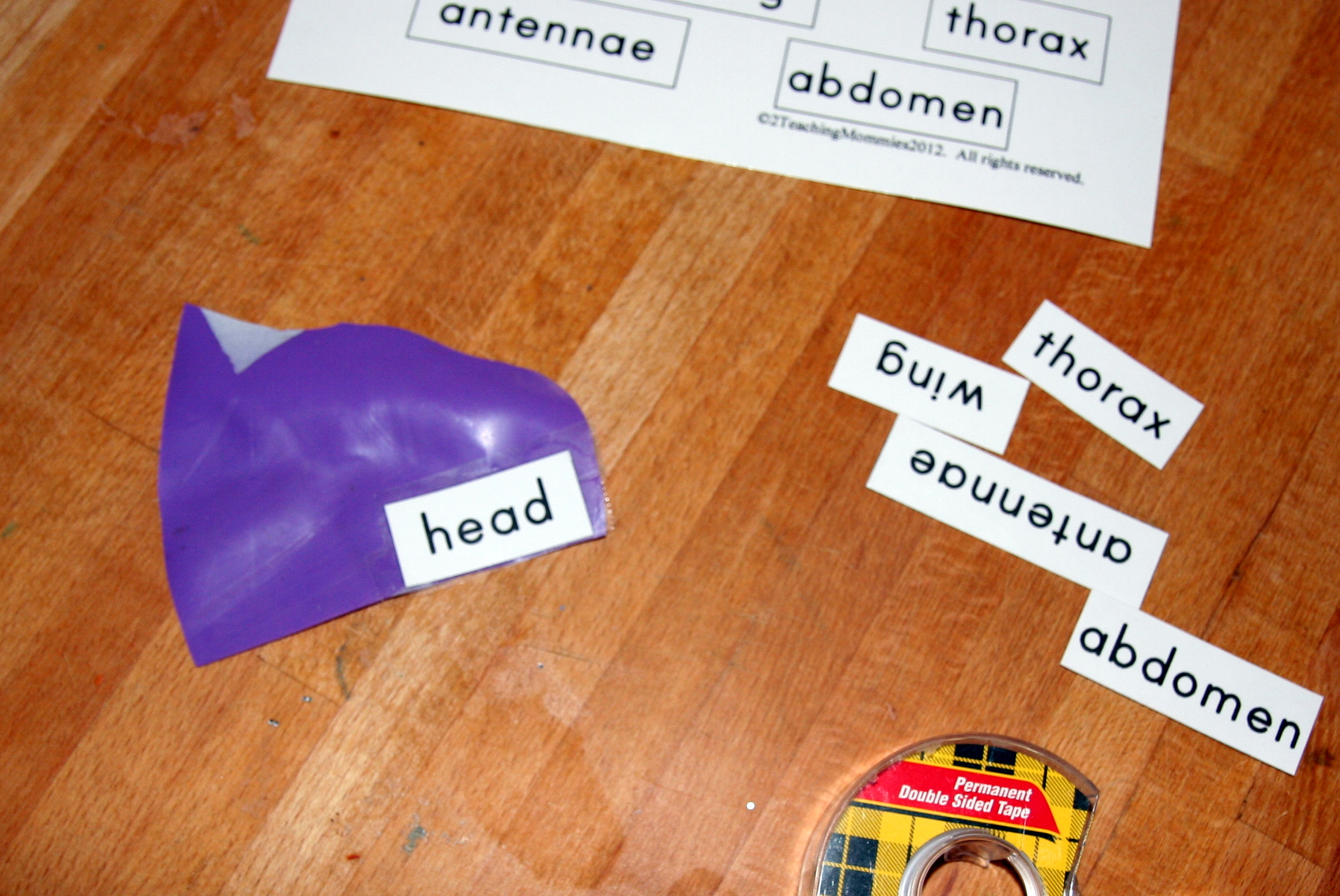
There's the game piece stuck to the outside of a piece of purple bouncie ball.

There’s the game piece stuck to the outside of a piece of purple bouncie ball.

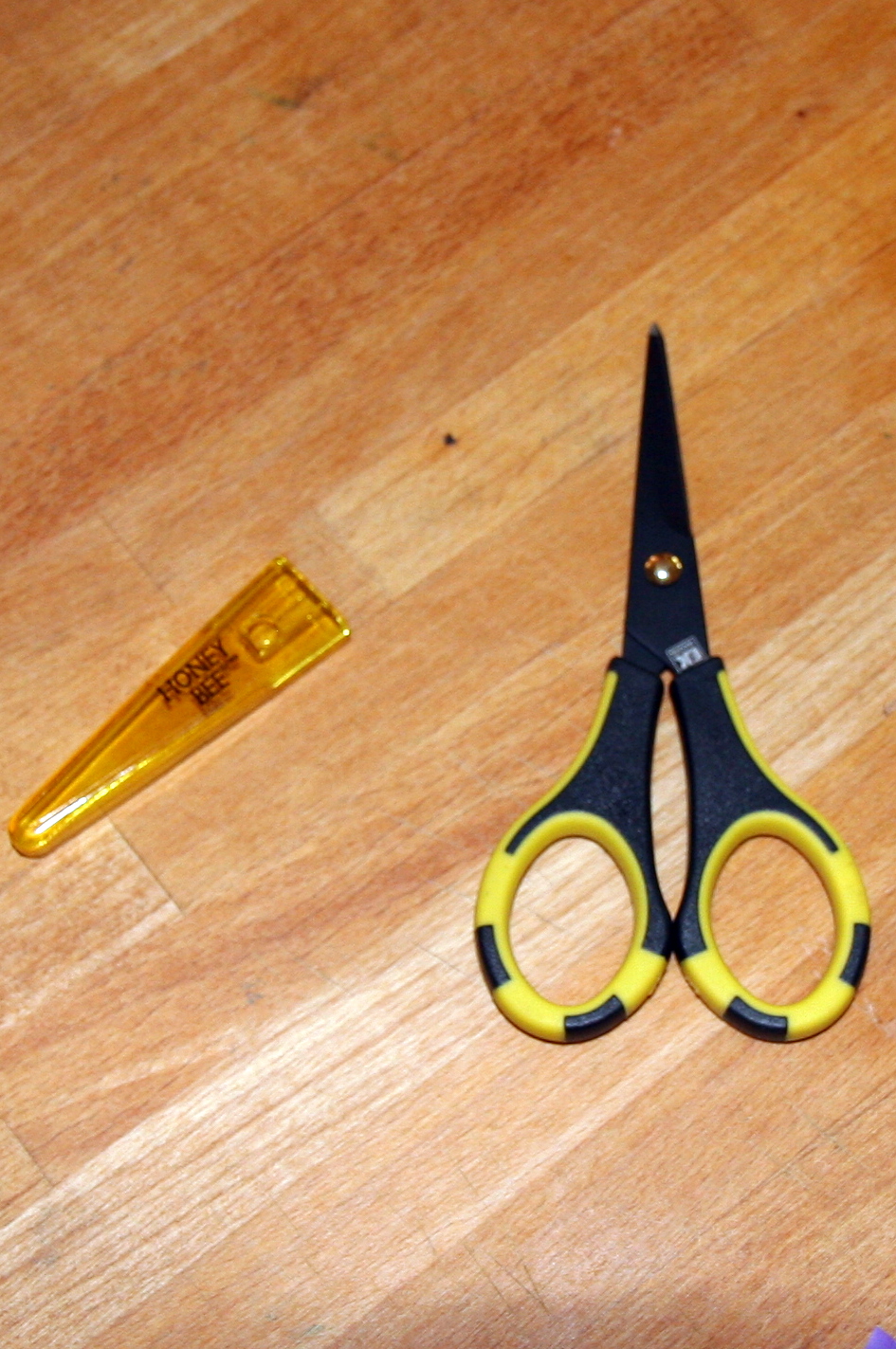
My Honey Bee clippers. There's no better scissors for tiny cutting. Maybe these are my craft crush. Life would be meaningless without them!

My Honey Bee clippers. There’s no better scissors for tiny cutting. Maybe these are my craft crush. Life would be meaningless without them!

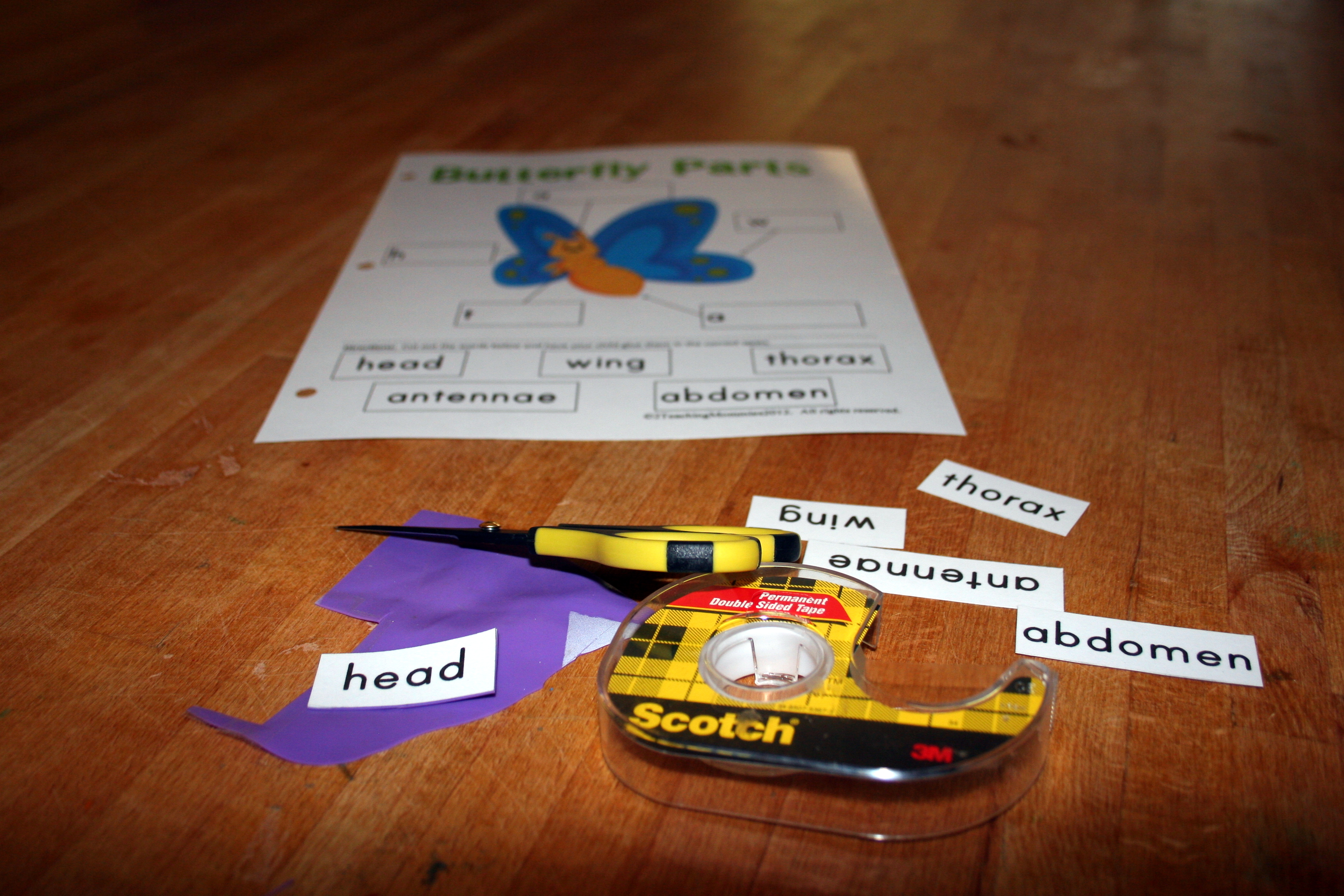
Group picture!!!!!

Group picture!!!!!


Final product! See how you can move the piece around so darn easily, and it temporarily sticks to smooth surfaces. This is the best trash to treasure idea I've ever had, if I do say so myself.

Final product! See how you can move the piece around so darn easily, and it temporarily sticks to smooth surfaces. This is the best trash to treasure idea I’ve ever had, if I do say so myself.

Categories: Homeschooling, Kid-o things

Happy Birthday to the BEST sister EVER!!!

20130607_180330.jpg

It’s my sister’s 40th birthday today, and besides my kids and my husband, she is my favorite person in the universe. I know that is so cliche, because little sisters often pretty much worship the ground their sisters walk on, but in this case, I have so much evidence that I actually do have the best sister ever. After all, she has gotten into fights for me, indeed, has even offered to lay down her life for me.

Let me tell you about her. When we were really little, we really liked each other. My earliest memory of my sister is when I was about 2 years old and our family drilled a well in the horse pasture, and my sister and I were allowed to play in the clay to our heart’s content. I clearly remember looking at my sister and thinking that she could do anything, and that I had no mud-playing skills compared to her. It was frustrating, but I wanted to watch her all day long so I could learn from her. I was hooked on her from that day forward. She was the smartest, prettiest, most obedient person I knew. She always knew how to do jobs quickly and correctly, how to keep her room clean, how to keep her things nice (her dolls always had shiny, silky hair), and she had the most amazing, long hair, while mine did not seem to grow past my shoulders. When she went to a friend’s house, the mother would comment on how nice it was to have her visit. When I went to a friend’s house, the mother would remark about me, “Well, she is NOT an angel!” In school she got straight A’s right from the start. It appeared that she didn’t even have to try. In school, I could barely achieve a C, try as I might. Everything just came out backwards and upside down for me. So at some point I realized that adults compared us a lot, and I came out on the bottom. We were so different from one another.

At some point, I began to feel jealousy toward my sister because of these (real or simply perceived) comparisons. That was when my mother instituted window washing, with one sister on either side of the window, hands had to wash at the same place at the same time, and the window had to be perfect before we could leave the task. If we fought while washing windows, or if we didn’t keep our hands in sync on either side of the window, we’d hear her sing out, “So many windows to wash! I am so lucky that I’ll have a second washed when that one is done!” We must have fought a lot because I remember washing windows every single day, staring at my sister’s face, learning to work together so we could stop washing. After a while, it worked, and we fought far less. But other things were going on at that time, as well. There were babies in the house. A LOT of them. 2 were foster babies, and one, in particular, was one we were to adopt. We all loved that baby very much, but it became obvious that his birth father was cleaning up his act (thank goodness!), and as he was a good father, the baby was re-unified. This was probably the first hardship my sister and I went through together. We lost our brother. When we were older, the three boys came along, and my sister and I suddenly found ourselves somewhat on our own. Not that our parents stopped parenting us, but we were expected to behave ourselves, get ourselves through school with good grades, and each help out with a baby on a daily basis. I remember one night, after my first brother was born, feeling very overwhelmed because I was so bad at school, and now I felt that my mom had even less time to help me. My sister had gone to private school for a year when she was in 7th grade, and she came to me when I was in 6th grade and very gently told me that it might be time to tell mom and dad I needed to leave homeschool to experience a different teacher who had more time to teach me so my mom could spend more time taking care of my brother. I was so relieved by this. I believed so strongly that my sister knew what was best in every single situation, and so I went to my parents and proposed that I stop home schooling and go to private school. I am certain the decision was much more my parents than mine, but at the time it seemed that my sister had such a great idea, and that my parents listened to her. Her idea was such a lifesaver for me. Not only did I thrive in traditional school, for the first time ever, I became confident that I was actually smart. I went from a C/D student to a straight A student. Things suddenly clicked for me. My sister helped me with pre-algebra and she had so many math tricks up her sleeve that I’d never understood before. I was so ecstatic that I was finally succeeding like she was. When my last brother was born, I was just about to enter high school, and because he had so many problems, my sister and I had to band together even more. She was so kind to me and mothered me through some really tough and lonely times. I am not sure she knew she was doing this, but she was. I knew I could count on her to listen to me, to let me sleep in her room when I was sad, to help me clean my room when I was overwhelmed, and even to help me with my chores, which I was not very good at. I clearly remember that with the birth of my last brother and our beginning high school, we became friends for the first time. I don’t mean convenient playmates, like we were as kids, but real friends. She helped me most by her uncanny ability to read people and know who was a good person to be with, and who was trouble. If people say I have a frightening ability to know a person’s character within a minute of meeting them, my sister has that kind of intuition within 10 seconds. She’s the smartest person I know.  When I was 9 years old, she told me I would marry Brandon, and she was right. She told me the friends in my freshman drama class were trouble and I should steer clear, and she was right. She cautioned me to be wary of those I had chosen as my closest friends, and she had very good reasons for her caution, and she was right. She taught me how to not get screwed over by people, that nobody but your family has your back, and she was right. We had so many very good conversations on those long car rides to and from school, and so really amazing fights, as well.

When I was 16 years old, I discovered that my sister loves me more than she loves herself, and that changed everything forever. We had been through a lot together before that, and were pretty good friends, and she had gone to live overseas for 6 months. I missed her every single day when she was gone. For the first time in my life, I had to face the world alone. I had very good training from my parents up to that time, so all was well, but I missed my sister as my friend and favorite confidant. My parents were good enough to let me go to Morocco to meet up with my sister at the end of my sophomore year in high school, and I jumped at the opportunity. My sister planned the trip, we were to travel Northern Africa and Western Europe over 2 1/2 months that summer, and we were going to do it on the extreme cheap. Our journey began with a 3rd class train ride in a 3rd world country where men were used to treating European women like prostitutes, and because we looked to them like Europeans, we found ourselves in a very tricky situation in the room between train cars. What I remember most were men coming at us, trying to do us harm, and when we fought back, trying to kill us by pushing us off the train, and my sister went into lioness mode. She stood in front of me, then sat on me, kicked at those men with all her might, and screamed for me to get out of there and leave her to fend them off. I told her they would kill her, and she said, “I don’t care, I just want you to be safe!” I couldn’t believe it. She was at that moment facing death for me, and facing it without flinching. To go through life with certainty that at least one person will lay down her life for you is a treasure most will never possess. I am one of the lucky ones, and my sister gave me that gift.

Not that I want my sister to die to have that certainty, and luckily it didn’t come to that. All ended well enough, although we had to pay them about 1/4 of our already-limited funds to get them to leave us alone. The rest of our trip through Europe was rather uneventful by comparison, and while we ate very little while there due to the dire state of our finances after the train incident, I did notice that my sister gave me more than she ate herself, probably because we both wasted away a little and were constantly hungry for those 2 1/2 months, and she didn’t want me to suffer.

We have been through many more tragedies together. We watched a wall of fire consume our property, our home, and we watched our father, his beard on fire, as he frantically tried to fight that fire with a garden hose. As we drove through the flames to safety with nothing but the clothes on our backs, I remember my sister squeezing my hand as tightly as she could, and she whispered, “We’ll be okay,” and I knew we would be. We have had far more happy times, together, though. My sister and I continue to be so different from one another, although we are more similar than I realized when we were kids. We both have more education than most people we know, and succeed in anything we do with highest honors and are better at it than our peers. Thanks to my sister who believed in me way back when she suggested I try traditional school, because she thought I was smart when nobody else thought I was, I have the courage to pursue life like that. Thanks to my sister, I understand how to guide my children to become amazing, courageous, virtuous individuals. Thanks to my sister, I know how to face the wind of tragedy head on, without wavering, and come out on the other side a far better person. Thanks to my sister, the happiness I have in life is far happier because I know that even if every other person in the world were to abandon me, she would still stand by my side, he head high in the air, here eyes fierce and wise and determined, and she’d whisper to me, “We’ll be okay.” And we would be.

Happy Birthday, to the best sister in the entire world! I love you so much! Here’s to another 40 years of insane adventures together!

🙂

Categories: Uncategorized

So, we are taking a summer road trip…Part 1

I love road trips. Our family took our first when I was about 2 years old, and I still remember the drive, where we went, who we saw, what I got in trouble for…but I mostly remember the utter thrill of being on the road. We took another road trip when I was 7, and then we took many plane trips to visit the East Coast folks, but nothing was as amazing as those long drives because when driving, you can actually SEE what you are passing. When you see an amazing attraction, you can stop and experience it. When a sign advertises “World’s best Popsicles” you can stop and get one.  In all, I’ve gone from ocean to ocean by car or bicycle at least 13 times, and have driven at least halfway another 8-10 times. I’m losing count! I’m in love with road trips. So when I had children, I was determined to give them the same love of the road that I have. So far, my 6-year-old has been on 3 road trips of more than 1000 miles each, and the other two kids have each been on 2. We are now preparing to embark on another trip covering about 2000 miles and over 4-5 weeks, part of that time I will be alone with my 3 kids on the road, and I am having a blast preparing our car activities.

We have had our share of in-car trials, certainly, but we have found that at least 90% of the time, our kids are happy and excited on road trips. We still remember the Sprite’s screams as we drove four hours on a desolate road through central California, a rout chosen for it’s beauty and views. Not fun. But she was not yet 1 year old at the time, and she was not amused by the landscape. She wanted to get out and PLAY!

People think we are nuts because they think road trips mean fighting, whining, many “are we there yet?” questions, and whining and complaining when the family finally arrives at the destination. We have found that with a little planning, and an understanding of how your kids work, the trip is instead filled with smiles and laughter, and the kids actually look forward to getting into the car. Now, if your kids have been raised to consider themselves allowed to be bored and whine a lot in general, even at home, then they will be whiny and board in the car. There’s no help for that except some good parenting counseling and a change in parenting style. But if your kids are normally content and happy and get along, it is extremely possible for them to love road trips, and for the road trip to be very pleasant for all! So let me tell you what we do.

1. We bring audio books. We listen to audio books ALL THE TIME at home, and the kids have their favorite series and books they like to hear again and again. We have been given Hank The Cowdog on CD over the years, and I believe we now have 23 of them. This amounts to about 100 hours of their favorite audio book! The best thing about audio books is that the kids can look outside and talk to one another while listening, so they are able to really take in a lot while driving.

Favorite books on tape:

1. The Story of the World Volumes I, II, III, and IV
2. Hank the Cowdog (all books are awesome!)

Thumblarge_9781591881018

                                                                                                                 3. The Little Prince

                    4. Stories read by Jim Wise Bauer Product Details

                                                                                                             5. Around the World In 80 Days (The Tim Behrens recording is my FAVORITE,   available on Audible.com)           Around the World In 80 Days | Jules Verne


2. File folder games. These are free ALL OVER THE INTERNET!!! They are awesome. I have made many file folder games, and the best way to do it is this: Use Google and/or Pintrest and search “free file folder games.” If you are using Google, click on the images search so you can see what the games are. This seems to make it a lot easier. Now, you’ll find a lot of games you need to pay for, but there are just as many (maybe more) you DON’T need to pay for. This is one of my favorite sites for file folder games. http://www.filefolderfun.com/SearchAge.html

File folder games are great because they are educational, so if you are planning on home schooling on your trip, finding a game that does the job for you pretty much rocks!

3. Printable worksheets. Each of my kids has a notebook. In the notebook are sections separated by binder dividers I found at Walmart. My 6-year-old has a section for coloring pages, one for daily journal entries, a section of mazes, dot to dot, matching, logic games, math facts for speed drills, etc. (all laminated in this section so they are write and wipe), and a section for family games like the license plate game, the ABC game, I Spy lists, I Spy Bingo, etc. I laminated these family games and found binder dividers with open pockets so the game sheets are easy access (important for those speed car games!). These binders are the core of our entertainment for the kids. They can slide between the boosters and car seats for easy access. I found all sheets for the notebooks by searching Google and Pintrest, all for free. All laminating is done at Lakeshore.

Some great sites I found:

http://preparednotscared.blogspot.ca/2010/06/preparedness-project-travel-bag.html

4. Flash card rings. For variation, I went to Lakeshore, Walmart, and Michaels and found all kinds of flash cards ranging from shape recognition for the Sprite to word recognition to math facts to puzzle cards – all sorts of cards that I gather all the time – as well as some flash cards I printed free from the internet, and I laminated the cards so they are write and wipe, and put them on a C-ring. I found an awesome, stiff, tote from Micheals, and all flash card rings go in the tote.

5. Supply pouches. All kids need their supplies easy to access and easy to organize, so I bought a BUNCH of $.88 clear binder pouches at Walmart. Each kid has 4 pouches, and all the pouches are attached to one another by C-rings. Pouch 1 contains washable markers. Pouch 2 contains twist-up crayons. Pouch 3 contains dry-erase markers. Pouch 4 contains lip balm, a tiny flashlight, a finger light (from Michaels $1 section), hand sanitizer, their personal game markers (more on that later) and all those other little things they might want during the car ride. The pouches are attached to their car seat or booster with a chain of C-rings. We have better luck with these than those plastic baby chains, as the baby chains tend to come apart and important things fall on the floor at critical moments.

6. Magnate boards with games. Each child has a baking sheet (sides are important so things don’t roll off!) and I printed off 12×12 game boards at Costco. This is how I made them. 1. I found a high-quality picture of the game board online and had it printed at Costco OR I took a picture of a game board we already have, cropped it into a square, and printed it as a 12×12 at Costco. 2. I created and printed any cards needed for the game, laminated them at Lakeshore. 3. I made personalized game markers. Each kid has their own. I bought little 1/2×1/2 wood cubes at some point in time, and put a little round magnate on the bottom. Then I printed a tiny picture of each kid’s face, laminated it, and glued it to the top of the cube. I made 2 for each kid in case one got lost. The game boards are held in place by magnetic strips I bought at Lakeshore, so nothing really slides around except for the cards, but the kids seem ok with this. I also printed, laminated, and magnetized a really cute road for the Mighty Lion, and we will bring his little Cars Drifters to play with on this road.

Magnate boards don’t have to be cookie sheets (they are cumbersome, but they also avoid most dropped toys). 12X12 dry-erase magnate boards would work as well.

7. Snacks: What we have discovered:

Kids are much happier when they snack on protein (cheese, lunch meat), fruit (berries, apples, bananas), and veggies (baby carrots, cherry tomatoes, edemame), and they drink water, and sugar is completely avoided. This is true at home, but even more true on the road. Sugar is your WORST enemy on the road. But you are on vacation, you want to give them treats, so what do you do? Our road trips go in this pattern: drive – get out and eat – play – drive. Kids may get back into the car hungry after playing, but if you want to give a treat, the time to do it is just after they get out of the car and before they play. Allow AT LEAST an hour of play if you are going to give treats. So when you pass that “World’s Best Popsicles” sign, you CAN pull over to indulge, just know that if you get into the car after consuming that amazing Popsicle, you’ll regret it.

So healthy snacks/no sugar/minimal carbs means a trip to the grocery store, but the investment in healthy foods pays off BIG TIME!!! I  can’t stress this more. We use this same principle when going to theme parks and hikes. Kids and sugar and planned occasions don’t mix.

8. When all else fails:

a. We do have an entertainment system in our van, but we barely use it. On road trips, the kids are allowed to watch 1 movie each day, and if there is any sort of argument about the movie, we say “Well, it sounds like you need a day to decide together what you want to watch, so no pressure, we’ll just put it off until tomorrow.” Problem solved. They will figure out what to watch together, and they’ll let you know when they’ve figured it out. Works every time, like a charm.

b. We have an IPad because my very kind MIL bought me one for work. I guard my IPad from my children because I want them to exhaust all other methods of learning and exploration before they embark on the brain-cell-killing, imagination-destroying, social-life-squashing journey into video games. However, I do have games for them on the IPad. All, without exception, are educational/religious games. I’ve even found a Greek learning game. Nice! This is our first trip since we’ve had it, and I’ll allow them to use it from time to time. I think I’ll allow each to play 30 minutes of games each day and  see how it goes. I can always withdraw that privilege if I need to.

9. Are we there yet? I found these great printables and am using the road trip countdown cards to write the name of towns we will pass that day. I laminated the cards, and will string a ribbon across the top of the van to clothespin them to. When we pass a town on a card, we can remove the card from the ribbon. They’ll always have a reference point, then. On our last trip, we introduced the kids to the road atlas, and whenever they asked “Are we there yet?” we looked at the map. They LOVED it! When you see this question as a blessing and a learning opportunity rather than a whiny bother, the incidence of the question decreases! Instead, the kids begin to look outside the car for road signs, and they learn how to use a map.

10. Get out of the car. That’s right. You have to plan to get out of the car BEFORE you need to. Know how long your kids can sit and play, and plan your trip accordingly. Don’t stress your kids out by asking them to drive 8 hours straight when they are 3 years old. Maybe they can do it, maybe they can’t. You just need to allow their abilities to factor into your planning. If you do this, they’ll LOVE road trips!

My kids beg us to take them!


Categories: Homeschooling, Kid-o things

“Just what each needs”

Almost a month ago I spoke with a woman who, like me, has 3 children and, like me, always imagined she would have at least 3 times that many. Like her, I have struggled, sometimes bitterly, for years with the fact that try as I might, and ask as I will, a large family is not something I am given easily or swiftly. Like her, many children have been given, some remain with me on earth, but just as many have been taken away. We talked about this for several minutes, and then something she said imprinted so deeply on my soul that I can’t stop thinking about it. It was so profound and true, and my focus completely changed at that moment. She said, “God gives our children exactly the number and type of siblings they need to live the way He asks them to live.” This blew my mind. Not to minimize life, but when a person looses a child, if that person believes the promises of God, the experienced sorrow is intense, but confined to missing the person, realizing that the separation is not eternal. The innocent and saved souls of the dead are to be envied in that the next thing they experience will be complete flourishing in the presence of God. Those left on earth, their siblings, are the ones we rightly ought to concern ourselves with, as they are the ones we continue to guide into the Kingdom of Heaven. God gives our children everything they need to flourish, including the siblings that will help them along the way. I suddenly understood my role as a mother in a brand new way. Part of guiding them in the love of God is guiding them in their experience of and with each other. Teaching them to live in harmony as brothers and sisters in Christ begins with teaching them to live in harmony with their brothers and sisters in their physical family. Everything clicked.

When my children had a very sick brother, they learned compassion, patience, and love well beyond their years. When, after pouring so much love and friendship into their brother, he passed away, they learned to deeply appreciate one another, to hold desperately onto one another. They understand that death may come to any one of them at any time, and they will once again kiss cold cheeks in a coffin and watch in horror as the dirt covers the grave.

My Little Magpie has such a bold, eager, anxious personality. The Mighty Lion has given her the daily gifts of his simple, tender, quiet nature, and the Sprite gives her the daily gifts of appreciation of beauty and moderation.

My Mighty Lion is naturally timid and desires nothing more than the path of least resistance. My Little Magpie gives him the daily gifts of courage and exploration through an insatiable imagination, and the Sprite gives him the daily gifts of laughter and mischief.

My Little Sprite is a little spoiled and tends to demand that others serve her and overlook her cute naughtiness. My Little Magpie gives her the daily gift of patience and protection, and calm instruction in responsibility, and My Mighty Lion gives her the daily gift of gentle roughness, compassion, and simple, clear explanations about how to get a job done quickly.

They are each exactly what the others need. It is my job to continue to guide them in loving one another in the ways the compliment one another.

And so people still ask me, “Why did you adopt a boy with such severe problems?” And now I have a very good answer for them: “God gave him to our children so that he could experience God through them, and so that God could teach them how best to love and enrich one another in the Kingdom of Heaven. If we had said, ‘no,’ we would have denied all four of them these divine gifts at the time God saw it was best to give them.”

Now, don’t get me wrong. My children quarrel at times, indeed, almost every day. However, they are remarkably able to resolve their conflicts among themselves without interference. If they need a parent to step in, they quickly and willingly take our advice. They WANT peace and unity among themselves more than almost anything else. But more than that, they all have an intense desire to know God. They recognize, because of the difficult experiences they have had, that God lives in our family and wants them to love and follow Him. A day does not go by that one or all of them don’t ask to hear another story about God, or ask deep questions about how they should go about vanquishing Satan’s power in our family and in their lives. Just today my Mighty Lion begged me to let him listen to a Bible story, and began crying. “I want to hear more stories about God so I can know more about who He is because I want to love Him!” They understand that we have one life to live, and then comes death, and so they must make the most of the time they have. They don’t like to waste a single moment, and the two things they say they want most is to love God and to see their brother again one day.

My Little Magpie has an extra desire to continue to root herself in this family, and she can’t wait to see Mr. Bug again, but she also can’t wait to meet all her other brothers and sisters who have died before they were born. We have talked about the babies who died before they were born to us, and the possibility that her birth mother also had babies die before they were born. She has so much family to meet one day, and this thrills her.

But “God gives our children exactly the number and type of siblings they need to live the way He asks them to live.” No more, no fewer. There is so much peace in this realization. 9 children would be nice, but 3 are just right for one another at this time. Maybe tomorrow we will get a call from our adoption worker, and we’ll know then that our children need another sibling for their days ahead. But when all is said an done, right now there is no reason to be anything but content, and that contentment is fresh and beautiful.

Categories: Uncategorized

So many questions these days

I have a secret crush on new homeschool curriculum. Okay, it’s not such a secret. I think every teacher, whether a home educator or not, gets a passionate thrill when the new books show up in the mail. It’s crack to us. I’ve had so many people ask us what we use and why, and what our day looks like, so I decided to write a blog post about it. So here is the answer, and I’ll answer in the following order:

1. Rod and Staff

2. Classical Conversations

3. A Beka math

4. Singapore math

5. The Story of the World

6. Song School

7. The Bible

8. A Child’s Garden of Verses

1. We use Rod and Staff as our core curriculum. http://www.milestonebooks.com/

We use every single subject except music and math, though I am considering switching from Singapore to Rod and Staff math. More on that later.

Why? First, because every single lesson is infused with high quality, challenging, theologically-infused material such that your child spends the entire day focusing mainly on learning who God is, why we ought to serve Him, and what a pure heart looks like, and then, secondarily, focuses on the subject at hand. The curriculum uses stories, rules, and repetition to teach subjects, and this fits squarely into the trivium framework. Third, we like that each core subject is divided into 150 school days, so you really have a 30-week school year laid out for you with virtually no time spent up front pouring over how to divide the work up each day. This is 6 weeks shorter than most other curricula  so yes, you do move a bit faster, but each lesson is so focused and successive lessons so well-related to the previous lessons that the pace is not problematic for normal children. Fourth, R&S requires that children become detail oriented, logical, caring individuals from the very beginning. This speaks to my old, unshakable European roots. Fifth, we love the simple format. No flashy pictures. All pictures are line drawings, if there are pictures at all. This means the books are very inexpensive, and the pictures are not distracting. Again, this fits squarely in the trivium framework where education is not the same as entertainment, and the distractions of technology and annoying cartoon pictures are so unnecessary. Sixth, simplicity is such an important discipline for the well-formed character in the virtuous life, and we wanted a curriculum emulating those values.  Seventh, with R&S, it is easy to form your child into an independent learner. This is SO important when you have more than one child. The Little Magpie is in 2nd grade and does easily 80% of her work on her own. I basically teach her new concepts each day, set her to her tasks, and then check her work when she is finished.  R&S does not have a formal kindergarten program. I come from the old school, Ramond More home school movement of the 80’s where kids are allowed to learn at their own pace, and if they want to begin when they are 4, they begin when they are 4. If they want to begin when they are 7, they begin when they are 7. So R&S really begins in grade 1, and any kid growing with free access to play and parents who read to them and answer their curiosities about numbers and letters will be able to handle this curriculum. We did very little with respect to writing or learning letters prior to embarking on the Grade 1 curriculum, and by the end of 1st grade, Little Magpie was reading easy chapter books, and by the middle of second grade she is reading at a 3rd grade level. We love this “later is better” approach. Bonus reason: Spending an hour hobnobbing with amazing, kind, quiet Amish women and children at the R&S booth at the curriculum fair is food for my soul and the highlight of my year!

Reading: Stories About God’s People. 

We do one lesson each day.

We have used this for first and second grade. Children learn to read by both sight words and a strong phonics foundation. As the child learns to write the letters, he will learn the sounds, and the reading will focus on words containing only the current and previous sight words, and letters learned that week. ALL reading is either scripture verses or detailed re-telling of Bible stories. The curriculum begins with Genesis and works on from there. Each lesson has a reading, a workbook page or pages teaching reading for details and comprehension, and a phonics page. There are fine motor worksheets for 1st grade, but we skipped these, as my kids have free access to art supplies and use them on a daily basis, so I didn’t see a need for structured cutting and pasting and coloring. The best thing about this reading program is that it kills two birds with one stone. It is Bible and Reading all in one. Nice.

The awesome thing is that the reading skills translate into other, non R&S books. She can read anything at all, and has learned to really care about comprehension (NOT something she naturally cares about) through the habituation process of this method.

Phonics

We do one lesson each day.

I love this phonics program. Why? Because I am a terrible speller. This program uses phonics to make spelling generally easy. After learning the phonics rules my daughter has learned in 2nd grade, I actually know how to spell more words…what? Great unintended consequence! Also, Little Magpie has proven to be an amazing speller, and I find that she recalls her phonics rules to help her with it. Also, the phonics program requires that kids memorize what things like a dipthong, a modified vowel, and a diagraph are. Why is this important to their little lives? Well, again, it helps with spelling.

Beyond spelling, though, the phonics program has allowed Little Magpie to read without fear. She is not naturally detail oriented, nor does she naturally love reading. She is a gross motor person, and sitting down to read is a task to be achieved as quickly as possible, not as perfectly as possible. But, again, the program is a method in habituation, and so she is slowly but surely coming to care about perfection in her reading and comprehension. While she reads, she does not fear big words, but sounds them out, and when she gets caught up on a difficult or unknown word, she can work through it with a few phonics prompts from me. And while she initially skipped over words she didn’t know, it now bugs her when she doesn’t know a word, and she comes to ask me.

Habituation in scholastic perfection…yeah, I’d say that’s a trivium value!

Grammar

We do one lesson each day.

I can’t say enough good things about R&S grammar. First, a lot of time is spent on teaching kids that the words we say mean important things, they are either true or false, and we must take care that our words are true and good, just as God’s are. Therefore, we should care that our sentences are also true and good, not only with respect to the subject, but with respect to the form the sentences take. They JUSTIFY caring about good grammar! Wow! By then end of second grade they have studied nouns, pronouns, verbs, and adjectives (We use our Winston Grammar cards along with R&S for extra emphasis, but this is only because I LOVE Winston Grammar so much, not because R&S needs supplementation.). Then in the last 25 lessons of 2nd grade, they introduce writing paragraphs. Up until this point, the most a child will have written are a few sentences each day, but not a huge emphasis on writing. Again, this is in line with the “later is better” method. Also, R&S tends to focus on art to teach fine motor rather than actual writing. The occupational therapist in me gets chills of approval!!!! No struggle during writing lessons because the kids don’t actually do writing samples until they are 7-8 years old. Perfect. Love it. They should be spending their time playing and exploring, not composing paragraphs!

Spelling

We do one lesson each week. Day 1, Exercise A, Day 2, Exercise B, Day 3 copy each word once, write each word once without copying when prompted, day 4 spelling test. Day 5 can be added, if an extra day is needed on a particular week.

Spelling loosely follows what is learned in phonics that week.

Science

We do one lesson each week, reading and filling in blanks on the same day.

We are a family that is in love with science, so I like the gentle approach and story-based science lessons in R&S, and again, the discussion is bathed in the knowledge and understanding that God created things just as He wanted them and each thing perfectly and for a purpose. It trains science into them as part of their education without making them into formal scientists yet. I still want my kids to explore creation on their own without educational restrictions, so this makes me happy. There is one lesson per week, starting in 2nd grade, and there are about 10 questions to fill out for each lesson. They learn things like what kinds of animals are on a farm, how they compare to wild animals, what weeds are, why we have seasons, and all kinds of other simple science concepts. We have so many other science books for them ranging from anatomy books to books about life cycles and dinosaurs and volcanoes on their kids bookshelf, alongside Dr. Seuss and My First Baby Animal picture books, so science has been a normal part of their lives from birth. I’m not worried about a formal science training right now. They’ll get that in later years. For now we just read a LOT to our kids from all kinds of books, including the ones discussing the parts of the eye ball and what happens in the dark trenches of the ocean.

Geography

We do one lesson each week, reading one day, filling in blanks for the lesson on another day.

Geography begins in second grade and is a very gentle, story-based introduction to history and geography. The history and geography curriculum eventually merge into one. Second grade focuses on the main countries in the world, the continents, types of land (mountains, prairies, hill country, etc.) animals unique to each continent, and the waters of the world.

Health and manners

We do one lesson each week.

This is very overt character formation within the framework of the Christian life and community. There are chapters on things like why you ought not tale bear, why we ought to help the elderly carry things and give up our chair to them, how we should treat those who look different than us, how to treat our siblings, how to view household chores, the place of a child in the home, the importance of silence…We really love this book!

Art

We do 1-2 projects each week.

This art program is aimed at increasing a child’s awareness of color, lines, the difference between dark and light, attention to what one’s hand is doing at any one time, and very fine motor skills. We use art rather than copious writing, as mentioned before. I really think it is the occupational therapy in me surfacing, but it is way more fun than writing paragraphs!

We also listen to The Story of the World, and the kids draw pictures of the history lesson while listening.

2.  We use Classical Conversations for some memory work

We memorize one cycle each week.

Why? We began to use it because people told us how great it was, how much their kids learned, and how easy it is to use. It is true, it is easy to use. It is true that kids memorize some really valuable pieces of information, but I am not having a passionate love affair with it. Here is why we continue to use it, with reservations. First, we are not part of a Classical Conversations (CC) community because they are not accepting of homeschool moms who work outside of the home and will not allow a sitter or tutor to accompany the child to the CC community if it conflicts with the mother’s work schedule. I find this to be unthinkable cliquishness for a Christian community, the kind of discrimination academic Christians have faced for centuries. But I find that the subject matter is VERY easy to figure out each week, so we don’t suffer from the lack of a day spent with the community. So it’s nice that it really is that easy to figure out. Second, kids memorize a history timeline, history facts, bits of Latin, quite a bit of geography, some great science facts, math facts, and grammar facts. I like the concept of memory pegs. Kids don’t really understand all of the concepts they are memorizing, but they will one day, and when they do, they will already have those concepts memorized from early childhood. More importantly, I have found, is the habit of memorization. We memorize a LOT each week. Third, the memory work goes hand in hand with The Story of the World, which we use for History. Fourth, all memory work is presented in both song and spoken word on a CD, so you can do this memory work in the car, and every single child in the family learns it together such that the 3-year-old sings about the Greek and Roman gods in line at the grocery store. That’s about it. There is a science experiment portion, a music portion, and an art portion, but we do Rod and Staff for art and science, and we use other methods for music, so we don’t feel this aspect of CC is needed as an add-on. There are some MAJOR drawbacks with CC. Our main problem with it is it is not overtly bathed in the Word of God on a daily basis. Our secondary issue with it is the corporate feel it has. The supplies are SO EXPENSIVE!!! I easily spend as much on just the CD’s and timeline cards as I spend on all my R&S curriculum combined! Then, if you are part of a community, you spend another $350 per child per year ON TOP OF any other extra fees. This is not an umbrella school. They don’t file your legal state paperwork for you or anything like that. It’s just one morning each week where “tutors” who have less knowledge about the subject than I do present the information to the kids. No thanks. I’ll do it myself and spend that $350/kid on Disneyland annual passes. Now THAT is a great educational place! (LOL!!!)

I go back and forth on this. If I did not teach during the community time, we’d likely join just for the socialization aspect, but I’d be disgruntled, I know!

3. A Beka math

We do 20 pages every 2 weeks (12 one week, 8 the next) for a 36-week school year.

I like A Beka. It is straightforward. It is not difficult, and it does not make things more complex than they really are. It is old-fashioned arithmetic. We have used A Beka for K-2 so far and really like it. Little Magpie CRAVES math, so we use 2 curricula  but for a child who is terrible at math or has some learning difficulties, I’d only use A Beka, or R&S as Singapore (below) would be far too challenging, I think. The story problems in R&S are theological in nature, so that is a plus. It is very easy to teach A Beka math at the lower grades, although I don’t know about the upper grades. I like that the kindergarten math book is not all about cutting and coloring and teaching shapes, as other math programs are. My kids already know all of those things by the time they are 4 and would think a math book focused on that is dumb. I never want to waste their time in school! By the end of kindergarten, kids know simple addition and subtraction by the end of the year, and are very familiar with story problems, telling time, reading temperature, simple division and measurement by inches and centimeters, and pounds and ounces. By the end of 2nd grade they have covered multiplication, division, fractions, and they have fully mastered time, money, temperature, etc.

4. Singapore math

We do about 10 pages per week in the text book and 10 pages per week in the work book.

This is the only subject book I need to go through and divide the pages up for so I know how much to present each day. We use it to supplement A Beka math for our little math-lover, and while it is divided up into 18 weeks, and each week is divided up nicely into 4-5 days for you,  we fit the entire week’s worth of work into 2 days, so I have to go through and customize the lesson lengths. We have used this for 1st and 2nd grade. I really like that this math curriculum is challenging and shows the reason behind arithmetic operations. I do find that there are way too many problems for each lesson. This is fine, since I just assign a certain number of problems, and there are always more if she needs more practice in something. I love the way the teacher’s manual shows you how to break things down step-by-step if you are not fresh on your math skills. You will need to purchase or make manipulatives for this program, but that’s not a big deal. If you have a printer and  a place to laminate, it’s cheap and easy, and the teacher manual tells what you need for the lesson. No guessing. If I had a child who was NOT a math wiz like Little Magpie, but is still good at and likes math, I’d use Singapore and not A Beka, I think.

The main issue I have with Singapore is it costs a FORTUNE!!! However, charter schools will pay for it, and only the work book is consumable, so it will be cheaper for the second and third kids.

5. The Story of the World

We go through 1-2 chapters each week for a 36 week school year.

There are 3 items for each of the four units of this program. 1. the text book, 2. the textbook on CD, 3. the activity and workbook. We mainly use the CD’s for our kids, as it saves me time because I can do something else during history lessons. The reader’s voice is captivating, and the subjects covered are very interesting, even for my 3-year-old. By 4, kids can actually follow the stories well, and by 5, they are asking for particular topics to be played over and over again. Yes, kids love this curriculum. It can be used through 6th grade, easily, and only the workbook is consumable, so it is well worth the money you spend because you’ll use all of it for all your kids, and if you have a scanner/printer, you can just copy the pages you need from the workbook, and only buy one set for your entire family. We like it that the reader has other CD’s with supplemental stories you can buy. We have several of the other CD’s, and the kids LOVE them! We won’t use anything else for many, many years, if ever!

While the kids listen to the chapters, I require that they draw a picture, or a series of pictures, of what they are learning about. They really love this, and it gives me some work to put into their binders in case we are ever investigated. I always want to keep a paper trail to show what we do.

6. Song School Latin, Greek, and Spanish. 

We listen to a few songs each day from each language and review vocabulary for those songs.

We bought all three language programs from Song School, and we are SO HAPPY we did! It is a very gentle introduction to these languages through song. This is particularly nice because, again, the little ones are learning along with Little Magpie. By the time the Mighty Lion begins 1st grade, he’ll already know most of the vocabulary, or he will at least be familiar with the basics of these languages. Most language programs don’t get serious until 3rd of 4th grade, maybe second grade, and this is the best program I have found for the younger years. It is far more serious than Putumayo’s CD’s (Fun, but not educational, per se), and not ridiculous and insulting, like Dora or the common DVD programs that are out there. We are going through the lessons in each book simultaneously so they learn the same vocab in each language each week, which has proven useful!

Along with this, Little Magpie writes a few Greek letters each week, as they are different than the letters the other languages use. I started her on this in 2nd grade, but wish I’d started it in 1st grade right after she was very familiar with the English alphabet. Song School Greek has letter-writing pages, but I just write the letters a few times for her, she copies them, and then finishes out the row herself.

7. The Bible

We memorize about 5 verses each week by 2nd grade.

We are also reading through Taylor’s Bible stories for kids, which is a nice alternative so all of the kids can understand the stories. Little Magpie is learning her way around the Bible through memorization, and we also attend BSF, so she is learning to find her way around while reading her lessons. We memorize large chunks of Scripture at once, rather than verse by verse. The reason we do this is I want her to know that verses have a specific context, as I don’t want her interpreting scripture as she wishes according to her whims, as is so common among churches in our era.

8. A Child’s Garden of Verses

We memorize 1-2 stanzas of a poem each week.

I love this collection of poems, as well as the fun, vintage pictures that go with it! We focus on diction and poise, as well as performance in front of an audience (whoever we can gather together!), and for a kid like Little Magpie who is not a perfectionist about anything, forming habits of proper diction is very important.

______________________________________________________________________________________________________

So that is what we use and why we use it, and how much we do each week. In kindergarten we spent 30-60 minutes once or twice each week, or whenever Little Magpie wanted to do some school. By 1st grade we were spending about 90 minutes each day on school, and then in 2nd grade we spend about 4 hours each day, including 2 20-minute breaks. By 2nd grade, though, I spend only about 1 hour with Little Magpie with school, and she does the rest on her own.



Categories: Homeschooling

Some people are mean to babies

Before we adopted and gave birth, we sat in foster licensing classes. In those classes, we learned that some people are mean to babies. Of course, everyone knows that there are moms and dads who are horribly cruel to their children, parents who do unspeakable things to their children. That is the main reason that children end up in the foster system. What we didn’t know is what we learned next: that STRANGERS are sometimes mean to babies AFTER they are adopted. This was a little hard to believe. We listened and I made a mental note to practice comebacks so I’d be ready and know what to say when I encountered one of these people.

Question: “Is that baby yours?” Response: “No, I found her wandering in the parking lot and decided to take her home.”

Question: “Do all your kids have the same father?” Response: “Yes. Do yours?”

Question: “Do you run a daycare?” Response: “No, I smuggle children for the Russian Mafia. I’m on my way to a drop-off.”

Question: “Did you adopt her from here?” Response: “No, she is an intergalactic traveler stuck in a time warp. We are putting her up until we can contact her fleet and return her to her alien species.”

Question: “Where did she come from?” Response: “Well, one night 2 people had sex, and a sperm and an egg hooked up.”

I could go on and on.

The thing is, this is Southern California. If America is the melting pot, Southern California is the blender. We have our pockets of people who have a problem with weird things like whose birth canal a child slid out of and whether a kid’s DNA matches the DNA of their parents, but most people get it that adoption is a really amazing thing, and a lot of people do it here. And then there are those who don’t get it. They have hang-ups about things like adopted children, particularly if those children happen to have skin that is more populated by melanin deposits than the parents who have adopted them.

In my experience, people who care about this are both black and white. What black people care about, in my experience, is that a little girl with dark skin is calling a person with lighter skin Mamma. What white people care about, in my experience, is their misconception that a child who has been adopted is necessarily a terrible person, headed for prison, a danger to their own children, a danger to the adopted child’s non-adopted siblings. Oh, and they could NEVER adopt. It’s just not something they can do.

And people believe that they have some kind of right and reason to comment on what they care about – in front of the adopted child.

Now, most people believe it is bad manners, at the very least, to go up to a parent of a child who is fat and say, in front of the child, “Can I ask you a question? Is that your child? (yes) Did you know your child is fat? Did you know that being fat means that they are not sexy or attractive to most people? Did you know that they are also way less likely to be healthy, and will probably die earlier? Did you know that, in general, we skinny folk eat less and exercise more and that as how we stay skinny, and your kid should eat less and be skinny as well? You should make your fat kid more like us skinny folk, and I’ll happily help you in any way I can!”

Most people also think it is bad manners, at the very least, to go up to a fat parent of a skinny child and say, “Can I ask you a question? Is that skinny child yours? (yes) Well I am skinny like your child and so I have special understanding our kind that you don’t have. Did you know that a skinny child needs to stay on a healthy diet and exercise a lot to stay skinny? We skinny folk understand this, and you are fat, so you obviously don’t know how to deal with a skinny child. Give me your phone number and I’ll call you and mentor you in how the skinny folk culture lives so your child will know how to act as she grows up. ”

Nobody does this.

However, at least once a month I encounter a person with no adopted children who is happy to tell me, in front of my 5-year-old adopted baby (The Little Magpie) a) how impressed they are that she is so well behaved, as she is obviously adopted, because they have known someone who told them, or heard somewhere, that adopted children, especially black adopted children, are a handful and end up in trouble and in prison, and b) that they can assure me that they do NOT think my black adopted child will end up in prison because I am obviously a super mom who was able to break her of her horribly black, adopted ways. My 5-year-old hangs on every word. I spend the next week mopping up the mess.

I also encounter, as often, a black woman who is happy to tell me, in front of my 5-year-old adopted baby, a) how sad it is that a black child has to grow up in a white family (The stranger passes by, stares at The Little Magpie, smiles sympathetically, and usually says something like, “Hello, my baby!” The Little Magpie HATES this. It makes her feel weird. The woman usually turns to me, then, and says, “Can I ask you a question? (sure) Is this your child? (yes) Is she adopted? (yes) How sad that they chose a white family over a black family for her! But she looks like she is doing all right?”) or b) how terrible they think her hair looks.

Now, I have researched black hair. I have taken classes on black hair. I have asked literally dozens of women how to take care of hair and which products to use. I have worked with The Little Magpie’s hair for 5 years. I have tried every product under the sun (well, at least a LOT of them!) I know something, although not everything, about black hair. I know there are as many recognized hair types for black people as there are for white people. I know that depending on your hair type, you need to use certain products, just like white people do. My own daughter has a very desirable hair type in the black community, except for one thing. It has a red tint. Now, there are at least 3 reasons a black person’s hair will be tinted red: 1) their hair is dry, 2) their hair has been color treated, or 3) they have a natural red tint to their hair. The little Magpie’s hair is incredibly soft, curly, and naturally tinted red because she’s not 100% black.

There is something else I know about black hair. I know that it is cutting edge these days for black women to “go natural” and let their tresses do as they will. Relaxers and straighteners and all those chemicals and extensions are recognized as not only bad for one’s hair, but bad for one’s health. The TTA/TWA (Teeny Tiny Afro/Teeny Weeny Afro) is “in” because people are shaving their heads, getting rid of all that chemical-laden hair, starting over. Again, we live in So. Cal. where natural is awesome. People are into urban farming here. People use soft-soled shoes on their kids, if they use shoes at all. People shop at health food stores and buy organic and belong to CSA’s. People have chickens in their back yards. Not everybody is like this, but it is common enough that it is seen as acceptable, and yes, normal. These all-natural people are usually under the age of 50, and even more commonly under the age of 40, and they were raised in a different world than the 50 and over crowd. It’s okay to be different. It’s okay to let your hair down. It’s okay to go barefoot.

Now, I get it that there are people who moved here from out of state who have not yet been caught by the blades of the So. Cal. blender. But we natives make allowances for them. They are cool. They’ll come over to our side one day, and if they don’t, they are still cool. We like people who are different.

Until they are mean to our babies.

Today I overheard a conversation. A woman walked into the Kinkos where we were making copies, and she was on the phone. She saw us, stopped in front of The Little Magpie, and said, “Hello, my baby!” The little Magpie didn’t miss a beat. She turned to me and almost yelled, “Why do people who look that way stare at me and call me their baby? I don’t like it!” (“people who look that way” are black people, BTW.) I said what I always say, “Well, it is because they think you are beautiful.” The Little Magpie went back to playing, clearly annoyed by both this woman, and my response, and I continued to make copies. What happened next was typical of these encounters. She went back to her phone conversation, and it went something like this:

“There is this little girl here…it’s so sad…she’s wearing torn clothes…she’s with a white lady…she looks so angry…her hair is not braided…well I’m going to say something about it…I’m not going to let this go…this is just wrong…”

Now, The Little Magpie was indeed wearing a skirt that had a tear in it. It’s one of her favorite skirts, and I have tried multiple times to throw it away, but each time she begs me to let her wear it just one more time. I relent. After all, it is her skirt, and I was small once, and endured the sadness of clothes disappearing from my closet. The Little Magpie was otherwise neatly dressed. She usually is. She had a brand new T-shirt on and really cute brand new designer sandals. The tear is about 1″ long, and other than that, the skirt is perfect.

And of course she looks angry. She is angry at YOU, lady!

And her hair. Her hair was in a ponytail when we left the house. I had washed it and neatly put it up the night before. It was nice this morning. However, when I went to smooth it down when we were standing in line at the store, she asked that her hair be let loose, and she brushed it herself. I am so happy that The Little Magpie is so independent. If she wants her hair loose, curls tossed by the wind, I will let her have it that way. It is her hair. She is learning to manage it on her own. She makes all kinds of wild hair-do’s, and she loves her creations. We have looked at pictures in black hair magazines over the years, and she invariably wants the full on Afro look over any braided, straightened, or relaxed look. And it’s our favorite look on her. Within the bounds of reason, I believe a child ought to have a say in the way she dresses and the way her hair looks. The Little Magpie looks around her, observes the hair of other black kids, and if she likes a look, and if it does not involve the use of chemicals, I’ll work her hair into that look. I am pretty darn good at those braided looks! I always ask her what she wants after her bath when we brush her hair. Tonight she asked for 2 french braids. Friday she asked to leave it out, and I convinced her to let me put it up in a ponytail. She took the ponytail out, and it’s her hair, so that’s fair. She can take it out.

If I try to explain these things to the women (always black) who take it upon themselves to direct me in her hair care, they invariably tell me, “You have to tell her that we do our hair this way and you don’t let her choose on her own.” Wait, “we?” Who is this “we” you speak of? You mean black people? That’s just not true. In fact, many people the world over who have “black” skin do NOT straighten, extend, and relax their hair like you do. It is false that this is the way “we” live, and it is false that it is even how “we” live in general.

But, it’s not about hair. It never is. I’ve come to this conclusion over the past 5 years. It’s about something else, and I don’t pretend to know what it is in every case. I can guess, though. I suspect it is about a white family adopting a black baby, and raising that baby to be free as a bird, within our moral and religious framework. What my life looks like, the way we live, looks quite different than the lives of most people we live around. We have an urban farm. Our kids hardly ever wear shoes. We home school. The Little Magpie learns Latin and Spanish in school. She memorizes poetry and Scripture and history. She is 5 and reads books meant for 2nd and 3rd graders. She can sit through a reading of Treasure Island and can follow the story and understand what is going on. She’s not raised the same way “they” are probably raising their children. Why do I say this? Well, we also know people who have “black” skin who think nothing of our adopting The Little Magpie. They are happy to answer questions I have about what I should do with her skin or hair, or even whether I should be teaching her more about “black” culture. Beyond that, they don’t bug me. They look beyond their prejudices about interracial families. So you have at least 2 types of people, and only the latter asks intrusive questions and makes intrusive comments: people who live a more alternative lifestyle, of one type or another, like we do, and those who live in the mainstream. And those who live in the mainstream. Those who live in the mainstream tend to very uncomfortable with those who do not, and tend to say terrible things to people who are different than them. So it’s not that black people say mean things to The Little Magpie. It is that certain types of black people say mean things to The Little Magpie. In the same way, it is not that white people are mean to The Little Magpie. It is that certain types of white people say mean things about The Little Magpie.

I suspect it is more than that, though. I suspect that a person who is willing to rail on me because The Little Magpie is clearly from a home different than theirs is a person who is guilty that they did nothing about the situation we have in America today. It is a fact that there are not as many black families willing to adopt as there are black children waiting for an adoptive home. It is a fact that white families ask for white babies more often than they are open to adopting whatever kid happens to be ready for adoption at that time. There are way more white people who want to adopt a white kid than white kids ready for adoption. People are picky. They tend to be into their own DNA. They are into their own skin color. They think there is some difference between them and “the other.” They are wrong. Everyone is wrong. Black people are wrong. They ought to be adopting more, and they ought to be happy whenever ANY child is adopted by a loving family, regardless of the color of everyone’s skin. White people are wrong, as well. They ought to understand that a child is a child, and their skin color is not what makes that child lovable. They are all wrong when they say, “I can’t adopt THAT! I could not love it if it were not my own. And THAT is prone to become a bad person despite my efforts.” No, you CAN adopt that. You CAN love it BECAUSE it IS your own. And IT is no more likely to be a bad apple than your own, precious, DNA-approved child that came from your own, amazing, unmatchable uterus. You ought to tell the truth. You WON’T adopt THAT. You WON’T love THAT as your own. You are better than THAT. You would not be able to show your proud face to your friends if your adopted kid happened to turn out bad. They are also all wrong when they say “YOU should not adopt THAT! That is one of US!” The truth is, “THAT” IS “US”!!! A human being is a human being. Our physical differences are just that, and if you believe that “you are not your body,” and focus on a person’s soul, then it becomes clear that DNA and the color of a person’s skin are irrelevant when it comes to one’s ability to love as a parent.

The weird thing is that it took me a while to get used to The Little Lion when he was born. He just didn’t look right. It was a very odd sensation to look at my newborn son and see so much bleached skin and glacial eyes staring back at me. He seemed sickly, like he need a good suntan to really survive in the world. At that moment, it occurred to me that I actually didn’t notice the color of The Little Magpie’s skin. She is one of us. She is our family, our first born, our pride and joy. Now, I DO notice it in the sense that I see her and I know my colors. Her skin is darker than mine.  However, when my kids tumble into a pile while they play, it never crosses my mind that one of these children did not come from my body or is darker than the others. In fact, it has gotten to the point that I forget that she did NOT come from my body. I will mistakenly say things like “when The Little Magpie was born,” and then I have to stop and realize that what I mean is “when she came to live with us.” This kind of experience is very normal in the adoptive parent population. It is unfathomable that they would be anything BUT yours. It is truly as if they came from your body.

People don’t get this. Regular black people don’t get this. Regular white people don’t get this. People who have adopted get this. People who approach adopted kids and their families as if the child were somehow suffering through their lives with their adoptive family, just waiting to leave home so they can finally be where they belong, with people who are the same color as they are, people who approach the situation that way are ignorent. Their statements confuse both the parents and the kids. Their questions are awkward and the questioner is pitied. The questions they ask are questions they would NEVER ask about non-adopted children. The advice they give is NEVER the advice they would give regarding the non-adopted children. If they did, everyone would think they were inappropriate and weird. Somehow, though, people think it is okay to impose their questions and advice with respect to The Little Magpie. In front of The Little Magpie. As if she is some kind of dog or some kid we are babysitting. As if The Little Magpie agrees with them and is wondering the same thing. I’m here to tell you. The things you are asking about and talking about never cross her mind.

Congratulations, you have just succeeded in confusing a stranger’s child and possibly destroying their proper identity as a full member of the family. The Little Magpie has already been robbed of the best case scenario – a birth family who loves and nurtures her and brings her up to be a good person. Now you are taking it upon yourself to potentially rob her security in the only family she remembers living with, the only family she knows, the family she loves, the parents who would die in an instant in her place, the family that loves her and nurtures her and is bringing her up to be a good person. YOU were not courageous enough to take her as your own. You are a now acting immorally by laying your guilt upon an innocent baby with your questions and advice.
Now, I finished my printing at Kinko’s, and was gathering my kids and our things to leave. Then I heard it. The question. “Can I ask you a question?” Something inside me snapped. All those responses I have prepared and used over the years were replaced in that instant. All those confused conversations with The Little Magpie as we walked away from yet another stranger asking questions ended at that moment. I suddenly got it that I owe them nothing but one kindly stated word: “No.” No, stranger, you may not ask a question. No, stranger, it is not your business whose uterus grew this child, whose sperm snagged whose ovum. No, the circumstances of her separation from the owner of the aforementioned uterus are NOT your business. No, my child’s desire to wear that skirt and brush her own hair is not something I will discuss with you. No, the color of your skin does NOT give you any ownership over The Little Magpie.

No.

Then I walked out the door with my lovely, unique, free-spirited children, hair flying, torn clothes, some without shoes. And we were all very, very happy.

Categories: Kid-o things

A New Kind of Saint

It’s been 8 weeks since we last made the drive down to Children’s Hospital. I’ve thought about visiting our liver transplant coordinator, I’ve thought about hand delivering a “thank you” note to the nurses and doctors who cared for him like family from the day he was born, I’ve even thought about writing a note to the parking attendants who were so generous with us all those days I lost my parking validation, those days I forgot cash, the days I was obviously distressed, when they said a kind word, let me pass for free, gave me the discount anyway. I knew them all by name.

It has been too hard to even think about that part of our life. It has been much easier, and I believe more healing, to forget all of that for 8 weeks. But not forever.

A lot has healed. We spent the first week after Kye Matthew’s death scrap booking. This was somewhat out of necessity, as I needed to have books ready for the memorial services, and I wanted to give them to family at that time, but it was also provided some much-needed distraction by very good memories about Kye Matthew. He was such a wonderful little boy. Every smile was perfect, even if filled with little green teeth! He was buried a week after he died, and we spent the next few weeks resting, cleaning, hugging children (I will write a post about my observations of my children’s grief one day, as it has been fascinating), and trying not to be alone. People have not bothered us, and have been very kind and gentle with us when we ignore them, which we are very grateful for. Semi-hermitage has been the perfect prescription for our grief. We called our adoption worker to start the long, laborious process of renewing our home study, and got the amazing news that we would NOT have to renew, that our old study would do! What joy, as we thought we would need to deal with paperwork for a new child while grieving for Kye Matthew. I had dreaded that for 2 months! With each passing week, I have been able to deal with one more Kye Matthew thing. His crib is still made up for him. Sometimes one of the kids sleeps in it to be close to him.  His wall art still hangs over it, his blankets are still in it, his stuffed animals still reside there. His toy basket still sits on the shelf, and I panic when other kids play with it (I’ve had to work really hard on this because his toys are SO FUN and really ought to be played with!). His clothes are still in his cubbies and in his closet. His diaper bag has gone untouched. I have come across random pieces of his laundry, and for weeks I could not wash them, but drank in the smell of his sweetness. We finally threw away his medicines and found a home for his medical supplies. Yesterday I took his car seat out of the car and put his car trip toys into storage. I gave his diapers away and put the second booster chair from the table into storage. Little by little, we are figuring out how to keep him around without keeping all those empty spaces around.

Last night, we made “the trip” again. The I-15 south in the carpool lane, the sound of fighter jets at Miramar, the carpool lane exit with only seconds to spare to make it onto the 163 south, passing the car dealers with all those “silly jumpping air men,” passing Montgomery field, looking out for the stork on Sharp Mary Birch, the Genesee exit, passing the courthouse and Juvenal Hall,  the parking structure with Ronald McDonald sitting creepily in front, and the hospital. It was odd to feel the weight of the world on our shoulders once again, and try to shake it off, because this time, our boy was not sick and dying, we were not here to visit him, we were here to remember him.

We made it to the Healing Garden and sat with all those other families who had lost their babies in the past 3 months. There was the family whose boy had an illness they would not name but had battled from birth. He died when he was 6. There was the baby who was “11 months old, 4 days shy of his 1st birthday,” who had been dropped off at daycare and had then inexplicably not woken from his nap. There was the family who’s boy had battled cancer for 4 1/2 years, and at age 9, he finally lost that battle. There was the 16-year-old girl whose family sobbed in the row in front of us, her little brother using an entire box of tissue while his older brother comforted him. There was Kye Matthew, whose life was so short but so blessed. And then there was the 17-year-old boy whose parents had fought for him from birth. His mother described him as “non-ambulatory and non-verbal,” and yet she never gave up on him. She talked about Children’s as her home away from home. Her boy had spent so much time there, they usually got the same room, knew other families, smuggled wine in to share in the common courtyards after the children were in bed, knew all the special places in the hospital, knew the best food in the cafeteria. They were like us, except they had done this for 17 years, not just 6 months.

It is odd that through all of this, the times I feel the most blessed is when I am with others who know exactly what we have gone through. There are so many people we love who have helped us, cheered us up, who have helped us in indescribable ways, but who don’t understand the depths of pain, the “what it is like,” to lose a child, thank God! I will always remember a man who came to talk to our class when I was in college, and he had lost both his arms in a chemical explosion at work. His wife died soon after, and he was left with 2 small children to raise and provide for – AND HE HAD NO ARMS!!! This man was amazing, he learned how to use his prosthetics like they were real arms. We all sat transfixed by his ability to turn pages, button his shirt, even get into his prosthetic contraption all on his own!  But I will always remember him telling us never to forget, as we worked with our patients, that until we lost our arms, we could not understand the depths of loss one experiences. And he told us not to try, and instead to thank God every single day that we still had arms and fingers to play the piano with (the ONLY thing he could not learn to do with his prosthetics!). He said that he didn’t want people to focus on his arms, to keep reminding him that they were gone. Instead, he wanted people to acknowledge that they were gone, and then be normal to him. But he said the most helpful times he spent, even after 40 years of dealing with his loss, were the times he met up with a person who, like him, had lost a limb. I wrote in my notes that day something like, “Don’t feel bad or weird if you can’t relate to a person with no arms. Thank God that you do have arms, and live the wonderful life God has given you, and be a friend to this person. Let those who have lost arms be the best comfort to others who have lost arms.” Weird the things you think about when a person is trying to comfort you in your loss, stumbling over awkward words, and you are thinking, you just don’t get it! But then God gives you the grace to be compassionate and accepting of their comfort by giving you a memory of a man in your class!

Those who have lost children, or have truly almost lost children, or whose children are gravely ill and in danger of dying, hold each other up, keep each other going, they say the right words with no awkwardness. They have been forced to accept what other parents hope never to accept. The parents of the 17-year-old were probably the most healing individuals I have met. They lived the life we understood was a real possibility for us, had our Kye Matthew survived aspergillus. Kye Matthew would not have been a well person. He likely would have suffered mentally from the oxygen deprivation he endured over the 6 weeks. He would likely be bed-ridden, for the most part. Every illness in his future would likely put him in mortal danger. He would suffer an early death after a lifetime of suffering, probably before he reached his 20’s. There would likely be no more running around, not more trips to the park, no more laughing around the table, no more wild shopping cart rides in the parking lot, no more Legoland, no more Zoo, no more Disneyland, no normal life. He would likely have spent a very significant portion of his life back in Bernardy Center at Children’s because his body would be too fragile to go home. But every life is worth living, and we were so excited about even this different life we were preparing to live with him. These parents had lived it. They were tired. Their faces showed extreme wear and tear. Their eyes were wide and wise. They had accepted the horrors of life on earth, because they had lived them. For 17 years, their son had a death sentence, and death finally caught up with him. Fear and suffering were an accepted way of life. The extreme inconvenience of raising a family in two places, an hour apart, was endured and overcome and accepted. And in the end, as devastated as they were to have lost their boy, they were relieved, just like us, and they understood this weird feeling of overwhelming grief and overwhelming relief. We were just getting to know the lifestyle of living with a very ill child. We only spent 6 months in love with our baby, willing to sacrifice all for him, and the re-adjustment to “normal” life has been somewhat easy. We only dealt with 2 major, extended hospital visits with our boy, the endured 17 years of them. Their re-adjustment to “normal” will never take place, because they have forgotten what “normal” is. They were such amazing, lovely, war-torn, wise, crazy people, they reminded me so much of ourselves, and they answered a question I had during all those 6 weeks we spent with our dying boy: Do we really have the strength to virtuously endure years of this? And the answer is “yes,” because as this couple said over and over again, “That’s what Mommies (and Daddies) do!” You make it happen.

And so I learned a very important lesson through comparison with them. We have been on a journey in our parenting lives, not having much concern for the immediate happiness of our children, but with great concern for the relationship with God and the virtue of each of our family members. We daily tend to our relationships with God, to our habits, to our souls. We have decided to obey God’s commandment to care for the widows and the orphans by getting our hands dirty, by going about the business of the Father in any way He sees fit. God has been gracious to us every step of the way, by first giving us an orphan to practice on, a beautiful, easily molded lover of goodness and God, a spunky little spitfire, in Kiki. He showed us that love for a child has absolutely nothing to do with whose belly they grew in, whose genes they have, what color their skin is, how long it takes to brush their hair, how many mothers they have previously had, how little you know about the time before you knew them, how much neglect they have endured, how many heartaches they have been through, and how determined they are NOT to care if they are abandoned by yet another family. Children are blessed with hope, and more hope, and more hope again, and those who fulfill that hope by giving them a forever home will be blessed by God in very amazing ways. With Kye Matthew we discovered that saying YES to God when called to do something a little more difficult, by giving a suffering child a chance to live well in his last months, by showing that child that his suffering need not be a lonely, horrible experience (I will always remember Sunshine holding his hand so many days when he was in the hospital being poked and prodded, or Kiki taking him from my arms and comforting him after he had labs drawn, or Judah giving him toys to play with and having “man talk” with him as we drove to yet another procedure, Kye Matthew sobbing in anticipation), by giving a modern-day “widow,” a teen birth mother, some kind of hope that her boy was living life well despite his serious physical illness and giving her a relationship where she was not judged but instead loved (and we love her desperately still!), by doing all of this God has blessed us with even more certainty that we can serve as thriving members of the Kingdom of Heaven to bring about His purpose on earth.

I am going to say something very controversial here, but I strongly believe I am right about this: Those who  are living lives to bring about the comfort and daily happiness of their children and themselves as a primary goal, are doing wrong. Instead, all parents should list the possibilities to serve in the Kingdom of Heaven (they are all there in the Bible, anyone can find quite a comprehensive list within an hour of searching) and pursue as many as they possibly can, with their children, change their lifestyle to TODAY! Oddly, God is right. You AND your children will be blessed (not that this should be a concern, as we ought to obey God even if we gain nothing), and your entire family will have the joy you have been chasing all along, and never find. So go ahead, adopt a child, or two, visit the sick every day, or every other day, make friends with a homeless man (yes, MAKE FRIENDS!), visit those who are imprisoned. Don’t sit around doing the procrastinating Christian’s avoidance thing of praying for God’s will about which is right for you. THEY ARE ALL RIGHT! You already know what you are good at, what gifts God has given you. Pick one and run with it. TODAY! We were never called to be happy. Not once does God place value on happiness. God places value on shalom, on serving in His kingdom, on caring for those who cannot care for themselves, and that is rightly where our efforts ought to be aimed. The care of your children’s souls, which is what God cares about, will be a natural consequence of your obedience to God, and they will learn to obey God through your obedience, and you and they will have shalom.

🙂

Categories: Mr. Bug

The Fruit of the Spirit week Three: Peace

This week’s study will focus on peace.

Day One: 

1. So call me a geek, but this week I found a pretty fun kid song, and we sang it rather than just reciting Galatians 5:22-23. Here is the link to it: http://www.youtube.com/watch?v=8j2PUWQa7fs&feature=related. Remember that you should not expect your little ones to know the entire verse yet. You are repeating it daily for them so they develop a strong familiarity with it, making it easier to memorize over the course of the coming weeks.

2. Say together, “But the fruit of the spirit is love, joy, PEACE!

3. Memory work for this week: I chose 4 very short verses that I thought encapsulated the concept of peace quite well.

Psalm 119:165
Great peace have those who love your law, and nothing can make them stumble.

Proverbs 12:20
Deceit is in the hearts of those who plot evil, but those who promote peace have joy.

James 3:18
Peacemakers who sow in peace reap a harvest of righteousness.

Isaiah 48:22
“There is no peace,” says the LORD, “for the wicked.”

John 14:27
Peace I leave with you; my peace I give you. I do not give to you as the world gives. Do not let your hearts be troubled and do not be afraid.

4. What is peace? On the first day, we will learn the Greek word for peace, the Hebrew word for peace, and the basic meaning of peace in teh Biblical context.

Greek: eirene

Hebrew: Shalom

Meaning: The word “peace” in the context of the Fruit of the Spirit is different than the concept of peace we normally think of. We usually think of peace as a lack of fighting and arguing, getting along. While this can be a part of the biblical concept of peace, it is not necessarily. Peace, in this context, focuses on a rightness with God through the Holy Spirit, and the resulting freedom from spiritual chaos. This freedom manifests itself by both an inward peace of soul and mind, as well as an outward act of influence on others to help bring the peace. In this way, one is a peace maker. One tends to one’s soul by love of the law of God (implying observation of the 10 commandments), habituating oneself in righteousness, and maintaining a flourishing relationship with God through the Holy Spirit. Emphasis should be put on the fact that one cannot experience peace without a relationship with the Holy Spirit.

As an example to illustrate, I used my children’s bedrooms. We talked about how their rooms look after playing with toys all day but not cleaning up after themselves. Their rooms can become a disaster! The longer they go without cleaning up their toys, the worse it gets, and the harder it gets to think about cleaning up. On occasion, their rooms have become so messy that they don’t even want to go into them. If they do go in, it can be dangerous, as they may trip on their toys and fall. When their rooms need to be cleaned, they always ask for help, whether the mess is small, or large. We try to help them by giving them tools they can use to clean their rooms themselves. They pick up all the things that go in one bin all at once, and then move on to things that belong in another bin. Ideally, they play with one bin, put those things away, and then play with another bin, and put those things away. If they do not attend to the bins, and if they fail to clean up as they play, chaos results. They have to tend to their rooms in the same way the have to tend to their souls. If they fail to be watchful, their rooms descend into chaos, and there is no peace in that room. Even peeking in through the door makes my children discontent and unhappy. When their room is this bad, they cannot actually clean the room without help. They can clean up some of it, but invariably I have to come in and help them complete the task. Just after we thoroughly clean their rooms, there is perfect order, and they love to play there. I explained to them that our Christian lives are much like our bedrooms, and our actions and relationships are much like our toys. When we have our actions and relationships organized and in order through the guidance of the Holy Spirit, we are able to keep things orderly, and we live well in the Kingdom of Heaven. When we ignore the Holy Spirit our lives descend into chaos. We are not discontent and unhappy. The only way we can restore order is through the guidance of the Holy Spirit. I stressed to them that God has been loving and made it easy to know how the Holy Spirit is guiding us, as He had given us the Bible, and prayer, and so we have everything we need to live lives free of chaos!

5. Craft: Today we made a contrast craft. I took 2 pieces of paper and taped them together, top to top, for each child, so that when laid out, you have something that looks like a book. Beforehand, I cut out several objects from white paper, a square and triangle for the pieces of a house, a trunk and simple bumpy “circle” as foliage  for the pieces of a tree, some simple bird figures, a sun, and gave 2 sets to each child. Now, this does mean you will do some cutting, but it really only takes a minute to cut these shapes out. I made 6 set for 3 children, and it took me all of 5 minutes. The printable for these pieces is Sun and house pieces. Now, contrast crafts come in many shapes and forms, but this one will go as follows: You take one set of shapes and have the kids close their eyes and scatter them around one of the blank sheets of paper. Then they open their eyes and glue each piece where it fell. Next, on the second sheet of blank paper, they will glue the pieces to make an orderly picture. When they are finished gluing, they can color the pictures. My kids thought their “chaos” picture was so funny and they talked about how silly and different it was than the picture ordered as the pictures should be. We also talked about the fact that each of them ordered the pieces in a different way, but they all knew, for example, that the tree trunk went below the foliage, and the roof went on the house. This gave us an opportunity to discuss the individuality of each relationship with God, such that there is a “way things ought to be” with respect to one’s relationship with God, each person’s struggles and strengths will be different, and so each relationship will look a little different, but a right relationship with God also always has certain things arranged in certain ways (roofs never go under the house, but sometimes a tree goes to the left of a house, and sometimes they go to the right). A right relationship with God is the goal, though, and it can be achieved through the Holy Spirit. Just like when we see a picture with objects scattered randomly about, and we say, “That is not the way it is supposed to look,” and then we can work to right the pieces, and we can succeed in putting them in the right order, we can also tell when our relationship with God is not in order, and we can work to right the pieces, and succeed in putting it in the right order.

Day Two

1. Say Galatians 5:22-23.

2. Say together, “But the fruit of the spirit is love, joy, PEACE!

3. Memory work for this week: Same as Day 1

4. What is peace? Yesterday we learned about the basic concept of biblical peace, which is a relationship with God that is ordered correctly. Today we will learn about some of the details regarding people who have peace. First, our memory verse (Psalm 119:165) tells us that those who love the law (implying obedience) have peace. What, then, is the law? For the purposes of this study, we will use the summary of the law, which is the 10 commandments. If your child does not yet know the 10 commandments, now is the time to present them. Children as young as 2 can memorize them, and early memorization makes early understanding of the law far easier. In our family, we usually say them every night, along with the Lord’s Prayer and the first part of the Shema. Second, those who plot evil do not have peace. Instead, they are deceitful, which means that they are in constant fear of being found out and punished. Fear is not compatible with peace, and so evil, deceitful people cannot have it. Those who do act with the goal of peace in mind will have joy, which we studied last week. Third, those who are wicked in general will not have peace.

5. Craft:

Supplies you will need:

1 sheet of white paper per child

washable finger paint or other washable paint

1 large paper plate per child

a smock or large t-shirt for each child, if you think your child may need it while using paint

a clear path to the bathroom for washing hands! 🙂

print out the 10 Commandments printable, one for each child

safe scissors – 1 pair for each child

glue

crayons or markers or colored pencils

Take a paint color and pour some onto the paper plate, one for each child. Let your child make a hand print of each hand on the piece of blank paper. You may want to have extra paper close by in case the hand print is not satisfactory to your child and another should be made. Next, wash your children’s hands and put the paint out of reach. Print one 10 commandments printable for each child. Have each child cut out each commandment, on the lines. Then, reading the commandments one by one, in order, glue one commandment on each finger of the hand print. Talk about what each commandment means, and why it is important to follow it, and why God might have thought each commandment was good for our souls.

Day Three

1. Say Galatians 5:22-23.

2. Say together, “But the fruit of the spirit is love, joy, PEACE!

3. Memory work for this week: Same as Day 1

4. What is peace? We have already learned the basics of peace, and now it is time to bring in lessons about Jesus. Today we learned that as hard as we try to obey the law and avoid being a wicked person, we constantly fail to be perfect. Even those who are well-habituated in goodness and obedience to God have sinned. We are therefore not at peace with God and atonement needs to be made. In week 1, we learned 1 John 4:10, and we learned about how God sent Jesus as the atoning sacrifice for our sins. In this lesson, then, we will rely on that verse to show us that paid the price for our sins so we can be at peace with God. This does not mean that we need not make every effort to obey God’s laws. After all, the Bible teaches us that those who avoid wickedness and obey the law are the ones who will have peace. And an ability to obey the laws of God is made manageable through the Holy Spirit. Those who have the Spirit are those who can obey the law, and have peace. Therefore, the fruit of the spirit (or the things one naturally achieves when one has the Spirit) is peace. It is a natural consequence of relying on the Holy Spirit to for the help we need to obey God’s laws.

5. Craft: Today I handed each of my kids a piece of paper and some markers and asked them to draw a picture of themselves with Jesus.  The results were quite interesting. As they drew, I asked them to explain their picture. They each wanted to draw two pictures, so I let them. The results were fascinating, funny, and insightful, as it allowed a perfect opportunity to discover how they see themselves with Jesus. I put their pictures into their binder.

Day Four

1. Say Galatians 5:22-23.

2. Say together, “But the fruit of the spirit is love, joy, PEACE!

3. Memory work for this week: Same as Day 1

4. What is peace? Today we talked about other kinds of peace we think of in the context of the Christian life. We focused on a lack of chaos in our home, and two issues came to mind. The first is a lack of chaos in our relationships with others. We tend to have a fairly peaceful home with respect to relationships, but we do have our share of arguments over toys or over who accidentally hurt who. We also talked about chaos between parents and kids, and there was general agreement that when we speak in kindness rather than anger, our days are peaceful even if we have a very busy day. The second is a lack of chaos in our environment. With 3 children, ages 5, 4, and 3, running around, the house and yard can very quickly descend into chaos. So we talked about our efforts to maintain a clean environment, what we can do to keep things cleaner, and ideas the children have about how they can help out. My children have responsibilities around the house (folding and putting away laundry from the time they can walk, helping with putting dishes away, picking up their toys, vacuuming, etc.) and so they were all able to have a lively discussion about what they could do to keep things orderly.

5. Craft: Today we made paper plate masks. I gave each of the kids a paper plate (a pretty flexible one) and asked them to draw a face showing a peaceful spirit. We cut out the eyes and stapled elastic to each side of the plate so they could wear their masks around that day.

Day Five

1. Say Galatians 5:22-23.

2. Say together, “But the fruit of the spirit is love, joy, PEACE!

3. Memory work for this week: Same as Day 1

4. What is peace? Review the biblical meaning of peace, the Greek and Hebrew words, and how one has peace.

5. Craft: Today we made a cross puzzle. The link to the cut-out is here: http://www.artistshelpingchildren.org/crafts-images/foam/foam-puzzle-cross.png

Before we started today’s lesson, I printed out a template for each of my kids and then glued the template to the back of some cute scrapbook paper. By the time we got to the craft, the glue was dry, and each of the kids cut out their puzzle along the lines. When each puzzle was in pieces, we talked about how the pieces were in chaos, but when they put the pieces together, the cross is as it should. The pieces are at peace!

Day Six

1. Say Galatians 5:22-23.

2. Say together, “But the fruit of the spirit is love, joy, PEACE!

3. Memory work for this week: Same as Day 1

4. What is peace? Ask each child this question, and discuss the answers of each.

5. Craft: Shrinky Dink charm

Here is the printable I used to print out the charms. Remember, colored pencils work best for this project.

Cross printable


Categories: Curriculum, Fruits of the Spirit, Homeschooling

Fruit of the Spirit Week Two: JOY

Week Two will focus on Joy.

Day One:

1. Say the verse Galatians 5:22-23 out loud to the family. Everyone who knows the verse can say it with you, or say the parts they know. By now, the kids should be able to say much of it with you just from hearing it repeated over and over. By this time, my kids are saying many of the fruits with each other during play time, and I find ample opportunities for helping they learn the order of the fruits each day.

2. Say together, “But the fruit of the Spirit is LOVE, JOY!” My kids love shouting out the fruits when we say this.

3. What is joy? Younger ones will understand a few important concepts about joy. Joy is what we have when everything is right, or the way it is supposed to be, in the Kingdom of God. There are four things I explained to my young ones, one concept per day. First, they will understand the mindset they are in when they get something they want, like for a birthday, or when they get to have what they asked for for dinner. Explain that this is part of joy, but it is a very small part because very soon the feeling of contentment may wear off as new desires arise. However, they will understand the mindset they are in, the happiness they feel, when they get something they want.

Part of learning about joy is learning about the opposite of joy. Today we talked about what it is like to want something really badly and to be denied again and again. My kids have wanted a puppy for 5 years, and especially my eldest has yearned almost daily. She has been denied a dog all that time, and she was often very, very sad that while all her friends were getting dogs, she did not get one. Birthday and Christmas after birthday and Christmas passed, and still no dog. We talked about how this yearning affected her and how hard it was to be completely content without that dog. We talked about why she wanted a dog so badly and what she thought she would gain from having one, and how her life did not seem right with each denial. She finally got a dog a few weeks ago, and she was filled with joy.

Each child has yearned for something over time and experienced denial again and again. Think of an example from your own children’s lives, and use that as an example in today’s lesson to replace our example of wanting a dog.

Older children: Older children should learn these four concepts regarding joy over the next few days, as well as learning about the Greek concept of blessedness/eudemonia as presented in the New Testament. A word study on blessedness and joy in scripture will likely suffice to give an understanding of elements of contentedness and peace of mind implied in the Biblical concept of joy/blessedness/eudemonia.

4. Memory work:

Ages Three and under: Psalm 66:1 “Shout for joy to God, all the earth.”

Ages Four to Five: Add Proverbs 29:6 Evildoers are snared by their own sin, but the righteous shout for joy and are glad.

Ages Five and up: Add Psalm 65:8 The whole earth is filled with awe at your wonders; where morning dawns, where evening fades, you call forth songs of joy.

5. This week, we are focusing on joyful experiences. We will focus on creation, singing and dancing, as well as art {My kids LOVE crafts, so we try to do one every day}. Today’s craft was a piece of white paper, so feathers, and some bird stickers, as well as star cut-outs. I asked the kids to think of God’s joyful creation, and birds in particular, as they created something with these items. I let them free-form anything they wanted. My eldest drew a bird and pasted the feathers onto it and the stars in the sky. My boy randomly pasted the feathers all around and talked about how birds fly so fast and sing loud, happy songs. He took the feathers and pretended they were birds and ran around the house a little as he made his project {It is always good to allow each child to express the lesson in their own way}. My youngest pasted the feathers in a neat row and talked about singing. Encourage discussion during this craft, as it is meant to inspire deep talks rather than a distinct finished product. Remember to keep each finished project in each child’s binder/notebook. By now, each child should have four to five pages of finished projects they will like to flip through.

Day 2

1. Say the verse Galatians 5:22-23 out loud to the family.

2. Say together, “But the fruit of the Spirit is LOVE, JOY!”

3. What is joy? Remember that joy is what we have when everything is right, or the way it is supposed to be, in the Kingdom of God. The second joy concept we will learn this week is that  joy is come by through our own actions of righteousness. Throughout Scripture, we find that joy is a result of the righteous life. It is the result of making conscious choices to do the right thing in every situation. Choosing to do what is right is part of reconciliation with God.

We have ample examples of children really trying to do right in our home, as do you, and I used these examples to demonstrate how hard it can be to do right, but how much joy comes from it. I asked the kids to think of righteous deeds they had done that day or the previous day, and we talked about the joyful consequences of their actions. We also talked about what might have happened had they made an unrighteous decision instead.

Learning about the opposite of joy: Today, talk about what happens when your children fight with one another. Discuss the sadness and anger they feel, and how they know that sadness and anger is something they don’t want. There is something wrong, all is not right, when they fight. It is more than just the fight itself. They also notice division among themselves, and that division is not eradicated until they reconcile. With my children, I have always used the words, “Make it right among yourselves” when there is a fight so that they begin to understand that there is a way things ought to be in relationships and a way things ought not be in relationships. We then talked about how unrighteous deeds makes your relationship with God wrong. Reconciling with God is necessary for joy, as it makes things right in that relationship once again, and our conscious effort to do righteous deeds is our outward demonstration to God that this relationship matters to us. The result of a right relationship with God is joy. To illustrate, I used a simply chunky puzzle and we put the pieces in together. I told them to try putting in the pieces upside down, and they looked at me weird. They knew that the puzzle piece needed to be made right before it could fit into the puzzle board. Even my two-year-old understood this concept.

4. Memory work: Same as Day One

5. Today we tied love in with our discussion of joy. I had leftover large heart cut-outs, and I asked each of the kids to draw a picture of themselves loving others by doing a righteous deed. They wanted something to glue onto their hearts, so I gave them sequins and these little person outline cutouts I got at Lakeshore. I put their heart projects into their binder. During our project, we sang our love verse songs as review.

Day 3

1. Say the verse Galatians 5:22-23 out loud to the family.

2. Say together, “But the fruit of the Spirit is LOVE, JOY!”

3. What is joy? The third concept of joy for the week is that living the righteous life is impossible without the sacrifice of Jesus on the Cross. Explain that as hard as we try, we can never be righteous enough to have joy in the Kingdom of God. We will always do something wrong, and so that relationship with God will be constantly broken unless there is a remedy.  Because of this, we need to accept the sacrifice of Jesus for our unrighteousness as the way God provided for us to have a right relationship with Him. Accepting Jesus’s sacrifice for our salvation is what marks us as a child of God and maintains our relationship with God even though we fail to be righteous all of the time. Accepting that sacrifice of Jesus as our Savior is how our joy is made complete.

Learning about the opposite of joy: This year in school, we learned about the creation of the heavens and the earth, and within our discussion of the heavens, we learned about things seen {stars and planets and such} and things unseen {God and souls and angels and such}. When we talked about souls, we went over what souls are and what happens to souls after death. With this background in place, today we discussed our relationship with God with respect to souls. Those who accept Jesus as their Savior have joy on earth and their souls stretch out to God daily. The souls of the righteous in Jesus can’t help but be joyful because they are marked with the blood of Jesus and they rest in that knowledge. They are now and forever will be with God. Souls that do not accept Jesus as their Savior are eternally seeking joy, and do not find it.

4. Memory work: Same as Day One

5. Today’s activity was not a craft. Instead, the kids put on blindfolds and I hid a fruit snack for each along with a little card I cut from card stock with the word God written on it. I told them to feel around the living room until they found it. I hid the fruity snacks on the mantle where they could reach them if they tried, but it would be next to impossible for them to find without sight. I let them search for about  minutes, and by the end, they were all slightly frustrated {I didn’t let them get to the point of becoming angry, just slightly frustrated} and the all really really wanted their fruity snack. I then let them take off their blindfold and search. They found their fruity snack within a minute, and my oldest was able to read the word God on the card. We then talked about how souls search and search for joy in God, and they are like people running around blindfolded. They get frustrated and angry, and sometimes they give up. This is the way they will exist for eternity. However, those who accept Jesus as their savior are like people who don’t have a blindfold, and they can easily find God, and joy, through Jesus.

Day 4

1. Say the verse Galatians 5:22-23 out loud to the family.

2. Say together, “But the fruit of the Spirit is LOVE, JOY!”

3. What is joy? The fourth concept of joy we talk about is that joy is found by observing God’s creation and standing in awe of God through His creation. When we look around us, we see amazing, beautiful animals, trees, flowers, mountains, etc., and we are filled with awe for the Creator, resulting in great joy. I asked them to close their eyes and think about the night sky and tell me what they “saw” and what they thought was amazing about it. I then asked them to do the same for mountains and animals and plants. We then talked about who is great enough to have created this [ only God ] and how amazing God must be to be able to create all of this out of nothing.

Learning about the opposite of joy: We have a lot of wild fires in our area, and our children are used to seeing burned areas, and areas that are then re-establishing themselves with plant life. For this day, we remembered places we have recently been where God’s creation has been burned. When we are in areas that are very recently burned, it is dusty and grey with nothing alive at all. Sometimes it feels scary to be in these places. We talked about how sad it makes us that the beautiful things God has made are gone from those areas. Then we remembered places that were burned in the more distant past, and how even in the desolation, God creates beauty, little by little, as the plants are re-born. Sometimes new plants we have never seen before grow beside the plants we are familiar with. I re-affirmed God’s love for all of creation, and his amazing ability to create anything, whether it be beautiful forests from burned areas, or the entire universe from nothing with his words, and how much awe we ought to have when we experience this.

Older Children: This would be an appropriate time to introduce the argument for the existence of God from design. A very understandable presentation can be found in Scaling The Secular City, by J.P. Moreland. You should be able to find this in most libraries.

4. Memory work: Same as Day One

5. Today we learned the hymn “This Is My Father’s World.” You can find it at http://www.youtube.com/watch?v=byIpfEVxhs4. We sang it while on a nature hike. Staying indoors for a craft just didn’t seem appropriate for today’s lesson.

 Day 5

1. Say the verse Galatians 5:22-23 out loud to the family.

2. Say together, “But the fruit of the Spirit is LOVE, JOY!”

3. Memory work: Same as Day One

4. If you didn’t get a chance to go on a nature hike on day four, I would encourage you to take time today to experience the joy of God’s creation by taking that hike today.

Today’s craft is making and decorating a dance shaker. These are really easy to make.

Supplies:

two paper plates per child

some dry beans, lentils,  unpopped popcorn, anything like that you have in your kitchen.

A stapler

some streamers

paint or markers

stickers or any other embellishments you have laying around the house

Okay, now get ready for the Dance for JOY dance party. Take two paper plates and place about twenty beans on one of them. Place the other plate face down on the first plate, and staple the edges together all the way around so the beans won’t fall out. Have your child color and decorate the plates for about 5 minutes. As the decorating is winding down, staple streamers onto the edges of the plates. Now crank up the music, shake those shakers, and dance for JOY!!!

Day Six

1. Say the verse Galatians 5:22-23 out loud to the family.

2. Say together, “But the fruit of the Spirit is LOVE, JOY!”

3. Memory work: Same as Day One

4. Today we made another Shrinky Dink charm. I printed bird outlines on a shrinky dink sheet [from Michael’s] and cut them out. Then I punched a hole in each, and let the kids color them. Colored pencils are by far the best choice for this as other color choices seem to stick in the cooking process. Then we baked the plastic and strung them up as necklaces. The kids LOVE this craft!

Categories: Curriculum, Fruits of the Spirit, Homeschooling

Proudly powered by WordPress Theme: Adventure Journal by Contexture International.